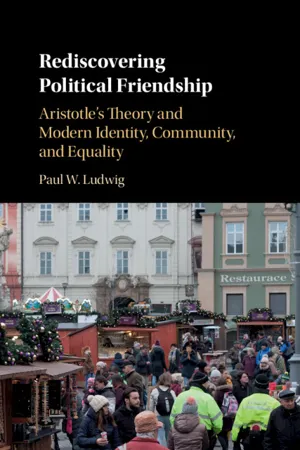
eBook - PDF
Rediscovering Political Friendship
Aristotle's Theory and Modern Identity, Community, and Equality
- 366 pages
- English
- PDF
- Available on iOS & Android
eBook - PDF
Rediscovering Political Friendship
Aristotle's Theory and Modern Identity, Community, and Equality
About this book
Aristotle argued that citizenship is like friendship, and this book applies his argument to modern society. Modern citizens may lack the concept of civic friendship, but they persist in many practices and passions that were once considered essential to it. Citizens share many similarities with friends: prejudices held in common, favoritism towards each other, and - despite disagreement on specifics - underlying agreement about what is important, such as freedom and equality. Aristotle's theory reminds us that civic friendship is a factual condition of healthy societies, not a pie-in-the-sky ideal. By recognizing when it occurs and understanding it, we can build on it to counteract societal polarization. Civic friendship offers an alternative to populism and nationalism by engaging some of the same passions. In an era increasingly marked by tribalism and identity politics, this timely study will be of interest to a wide range of readers in political science, classics, and philosophy.
Information
Topic
PhilosophySubtopic
Ancient & Classical PhilosophyTable of contents
- Cover
- Half-title
- Title page
- Copyright information
- Dedication
- Epigraph
- Contents
- Preface and Acknowledgments
- Introduction
- Part I Foundations of Friendship
- Part II Where Is Civic Friendship Today?
- Part III A Different Way to View Liberalism
- Part IV Conclusion
- Works Cited
- Index
Trusted by 375,005 students
Access to over 1.5 million titles for a fair monthly price.
Study more efficiently using our study tools.
Frequently asked questions
Yes, you can cancel anytime from the Subscription tab in your account settings on the Perlego website. Your subscription will stay active until the end of your current billing period. Learn how to cancel your subscription
No, books cannot be downloaded as external files, such as PDFs, for use outside of Perlego. However, you can download books within the Perlego app for offline reading on mobile or tablet. Learn how to download books offline
Perlego offers two plans: Essential and Complete
- Essential is ideal for learners and professionals who enjoy exploring a wide range of subjects. Access the Essential Library with 800,000+ trusted titles and best-sellers across business, personal growth, and the humanities. Includes unlimited reading time and Standard Read Aloud voice.
- Complete: Perfect for advanced learners and researchers needing full, unrestricted access. Unlock 1.5M+ books across hundreds of subjects, including academic and specialized titles. The Complete Plan also includes advanced features like Premium Read Aloud and Research Assistant.
We are an online textbook subscription service, where you can get access to an entire online library for less than the price of a single book per month. With over 1.5 million books across 990+ topics, we’ve got you covered! Learn about our mission
Look out for the read-aloud symbol on your next book to see if you can listen to it. The read-aloud tool reads text aloud for you, highlighting the text as it is being read. You can pause it, speed it up and slow it down. Learn more about Read Aloud
Yes! You can use the Perlego app on both iOS and Android devices to read anytime, anywhere — even offline. Perfect for commutes or when you’re on the go.
Please note we cannot support devices running on iOS 13 and Android 7 or earlier. Learn more about using the app
Please note we cannot support devices running on iOS 13 and Android 7 or earlier. Learn more about using the app
Yes, you can access Rediscovering Political Friendship by Paul W. Ludwig in PDF and/or ePUB format, as well as other popular books in Philosophy & Ancient & Classical Philosophy. We have over 1.5 million books available in our catalogue for you to explore.