eBook - PDF
Music and Musicians at the Collegiate Church of St Omer
Crucible of Song, 1350–1550
- 332 pages
- English
- PDF
- Available on iOS & Android
eBook - PDF
About this book
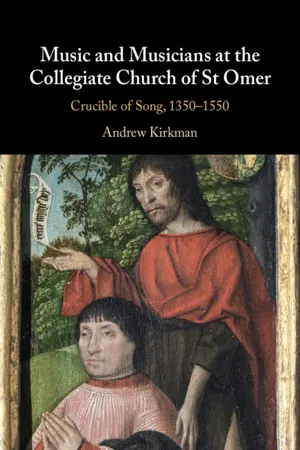
Music played an exceptionally important role in the late Middle Ages - articulating people's social, psychological and eschatological needs. The process began with the training of choirboys whose skill was key to institutional identity. That skill was closely cultivated and directly sought by kings and emperors, who intervened directly in recruitment of choirboys and older singers in order to build and articulate their self-image and perceived status. Using the documentation of an exceptionally well preserved archive, this book focuses on music's functioning in an important church in late Medieval Northern France. It explores a period when musicians from this region set the agenda across Europe, developing what is still some of the most sophisticated music in the Western musical tradition. The book allows a close focus not on the great achievements of those who cultivated this music, but on the personal motivations that shaped their life and work.
Information
Subtopic
MusicTable of contents
- Cover
- Half-title
- Frontispiece
- Title page
- Copyright information
- Epigraph
- Contents
- List of Figures and Map
- Acknowledgements
- Note on Editorial Policy, Currency and Dates
- Prologue: Saint-Omer and the Growth of Urban Power
- 1 The Maîtrise
- 2 Identities and Career Patterns
- 3 Masters and Master Singers
- 4 The Organs
- 5 The Bells
- 6 Loose Canons? Music and the Craft of Ecclesiastical Power
- Epilogue: A Cloistered Art: Connoisseurship and Private Music-Making
- Appendix Documents Pertaining to the Suppression of Benefices for the Upkeep of the Master and Choirboys (See Chapter 1)
- Bibliography
- Index
Trusted by 375,005 students
Access to over 1.5 million titles for a fair monthly price.
Study more efficiently using our study tools.
Frequently asked questions
Yes, you can cancel anytime from the Subscription tab in your account settings on the Perlego website. Your subscription will stay active until the end of your current billing period. Learn how to cancel your subscription
No, books cannot be downloaded as external files, such as PDFs, for use outside of Perlego. However, you can download books within the Perlego app for offline reading on mobile or tablet. Learn how to download books offline
Perlego offers two plans: Essential and Complete
- Essential is ideal for learners and professionals who enjoy exploring a wide range of subjects. Access the Essential Library with 800,000+ trusted titles and best-sellers across business, personal growth, and the humanities. Includes unlimited reading time and Standard Read Aloud voice.
- Complete: Perfect for advanced learners and researchers needing full, unrestricted access. Unlock 1.5M+ books across hundreds of subjects, including academic and specialized titles. The Complete Plan also includes advanced features like Premium Read Aloud and Research Assistant.
We are an online textbook subscription service, where you can get access to an entire online library for less than the price of a single book per month. With over 1.5 million books across 990+ topics, we’ve got you covered! Learn about our mission
Look out for the read-aloud symbol on your next book to see if you can listen to it. The read-aloud tool reads text aloud for you, highlighting the text as it is being read. You can pause it, speed it up and slow it down. Learn more about Read Aloud
Yes! You can use the Perlego app on both iOS and Android devices to read anytime, anywhere — even offline. Perfect for commutes or when you’re on the go.
Please note we cannot support devices running on iOS 13 and Android 7 or earlier. Learn more about using the app
Please note we cannot support devices running on iOS 13 and Android 7 or earlier. Learn more about using the app
Yes, you can access Music and Musicians at the Collegiate Church of St Omer by Andrew Kirkman in PDF and/or ePUB format, as well as other popular books in Media & Performing Arts & Music. We have over 1.5 million books available in our catalogue for you to explore.