eBook - PDF
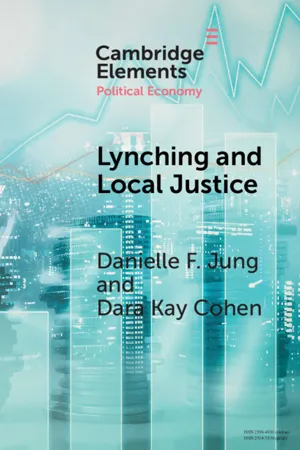
Lynching and Local Justice
Legitimacy and Accountability in Weak States
- 104 pages
- English
- PDF
- Available on iOS & Android
eBook - PDF
Lynching and Local Justice
Legitimacy and Accountability in Weak States
About this book
What are the social and political consequences of poor state governance and low state legitimacy? Under what conditions does lynching – lethal, extralegal group violence to punish offenses to the community – become an acceptable practice? We argue lynching emerges when neither the state nor its challengers have a monopoly over legitimate authority. When authority is contested or ambiguous, mass punishment for transgressions can emerge that is public, brutal, and requires broad participation. Using new cross-national data, we demonstrate lynching is a persistent problem in dozens of countries over the last four decades. Drawing on original survey and interview data from Haiti and South Africa, we show how lynching emerges and becomes accepted. Specifically, support for lynching most likely occurs in one of three conditions: when states fail to provide governance, when non-state actors provide social services, or when neighbors must rely on self-help.
Information
Table of contents
- Cover
- Title page
- Copyright page
- Lynching and Local Justice
- Bibliography
- Acknowledgements
Trusted by 375,005 students
Access to over 1.5 million titles for a fair monthly price.
Study more efficiently using our study tools.
Frequently asked questions
Yes, you can cancel anytime from the Subscription tab in your account settings on the Perlego website. Your subscription will stay active until the end of your current billing period. Learn how to cancel your subscription
No, books cannot be downloaded as external files, such as PDFs, for use outside of Perlego. However, you can download books within the Perlego app for offline reading on mobile or tablet. Learn how to download books offline
Perlego offers two plans: Essential and Complete
- Essential is ideal for learners and professionals who enjoy exploring a wide range of subjects. Access the Essential Library with 800,000+ trusted titles and best-sellers across business, personal growth, and the humanities. Includes unlimited reading time and Standard Read Aloud voice.
- Complete: Perfect for advanced learners and researchers needing full, unrestricted access. Unlock 1.5M+ books across hundreds of subjects, including academic and specialized titles. The Complete Plan also includes advanced features like Premium Read Aloud and Research Assistant.
We are an online textbook subscription service, where you can get access to an entire online library for less than the price of a single book per month. With over 1.5 million books across 990+ topics, we’ve got you covered! Learn about our mission
Look out for the read-aloud symbol on your next book to see if you can listen to it. The read-aloud tool reads text aloud for you, highlighting the text as it is being read. You can pause it, speed it up and slow it down. Learn more about Read Aloud
Yes! You can use the Perlego app on both iOS and Android devices to read anytime, anywhere — even offline. Perfect for commutes or when you’re on the go.
Please note we cannot support devices running on iOS 13 and Android 7 or earlier. Learn more about using the app
Please note we cannot support devices running on iOS 13 and Android 7 or earlier. Learn more about using the app
Yes, you can access Lynching and Local Justice by Danielle F. Jung,Dara Kay Cohen in PDF and/or ePUB format, as well as other popular books in Economics & Political Economy. We have over 1.5 million books available in our catalogue for you to explore.