eBook - PDF
Women, Language and Politics
About this book
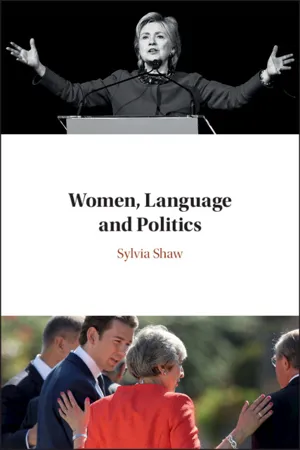
This book addresses the problem of the underrepresentation of women in politics, by examining how language use constructs and maintains inequality in political institutions. Drawing on different political genres from televised debates to parliamentary question times, and fifty interviews with politicians between 1998 and 2018, the book identifies the barriers and obstacles women face by considering how gender stereotypes constrain women's participation, and give them additional burdens. By comparing the UK House of Commons with newer institutions such as the Scottish Parliament, the National Assembly for Wales, and the Northern Ireland Assembly, it asks: how successful have newer institutions been in encouraging equal participation? What are the interactional procedures that can be thought of as making an institution more egalitarian? It also explores the workings and effects of sexism, fraternal networks, high visibility in the media, and gendered discourses, through detailed case studies of Theresa May, Julia Gillard and Hillary Clinton.
Information
Table of contents
- Cover
- Half-title page
- Title page
- Copyright page
- Dedication
- Contents
- List of Figures
- List of Tables
- Acknowledgements
- List of Abbreviations
- Transcription Conventions
- 1 Introduction
- 2 Gender and Language in Political Institutions
- 3 Women’s Linguistic Participation in a Traditional Male-Dominated Forum – The UK House of Commons
- 4 Women’s Linguistic Participation in the New Devolved Assemblies of the UK
- 5 Barriers to Women’s Participation in Politics
- 6 Case Study: Theresa May
- 7 Case Studies: Julia Gillard and Hillary Clinton
- 8 Women, Language and Politics: Gains and Losses
- Appendix A: Description of the House of Commons Data Corpus 1998–2001
- Appendix B: Description of the Devolved Parliaments Data Corpus 2009–11
- Appendix C: Adversarial Language in the May–Corbyn Prime Minister’s Question Times
- Notes
- References
- Index
Trusted by 375,005 students
Access to over 1.5 million titles for a fair monthly price.
Study more efficiently using our study tools.
Frequently asked questions
Yes, you can cancel anytime from the Subscription tab in your account settings on the Perlego website. Your subscription will stay active until the end of your current billing period. Learn how to cancel your subscription
No, books cannot be downloaded as external files, such as PDFs, for use outside of Perlego. However, you can download books within the Perlego app for offline reading on mobile or tablet. Learn how to download books offline
Perlego offers two plans: Essential and Complete
- Essential is ideal for learners and professionals who enjoy exploring a wide range of subjects. Access the Essential Library with 800,000+ trusted titles and best-sellers across business, personal growth, and the humanities. Includes unlimited reading time and Standard Read Aloud voice.
- Complete: Perfect for advanced learners and researchers needing full, unrestricted access. Unlock 1.5M+ books across hundreds of subjects, including academic and specialized titles. The Complete Plan also includes advanced features like Premium Read Aloud and Research Assistant.
We are an online textbook subscription service, where you can get access to an entire online library for less than the price of a single book per month. With over 1.5 million books across 990+ topics, we’ve got you covered! Learn about our mission
Look out for the read-aloud symbol on your next book to see if you can listen to it. The read-aloud tool reads text aloud for you, highlighting the text as it is being read. You can pause it, speed it up and slow it down. Learn more about Read Aloud
Yes! You can use the Perlego app on both iOS and Android devices to read anytime, anywhere — even offline. Perfect for commutes or when you’re on the go.
Please note we cannot support devices running on iOS 13 and Android 7 or earlier. Learn more about using the app
Please note we cannot support devices running on iOS 13 and Android 7 or earlier. Learn more about using the app
Yes, you can access Women, Language and Politics by Sylvia Shaw in PDF and/or ePUB format, as well as other popular books in Languages & Linguistics & Linguistics. We have over 1.5 million books available in our catalogue for you to explore.