- 227 pages
- English
- PDF
- Available on iOS & Android
eBook - PDF
Politics, Identity, and Mexico’s Indigenous Rights Movements
About this book
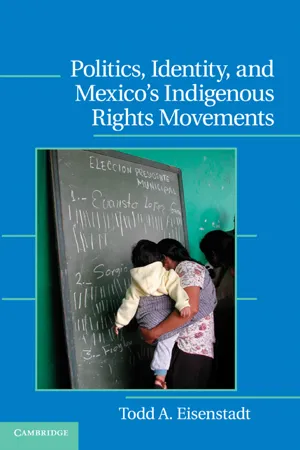
Drawing on an original survey of more than 5,000 respondents, this book argues that, contrary to claims by the 1994 Zapatista insurgency, indigenous and non-indigenous respondents in southern Mexico have been united by socioeconomic conditions and land tenure institutions as well as by ethnic identity. It concludes that - contrary to many analyses of Chiapas's 1994 indigenous rebellion - external influences can trump ideology in framing social movements. Rural Chiapas's prevalent communitarian attitudes resulted partly from external land tenure institutions, rather than from indigenous identities alone. The book further points to recent indigenous rights movements in neighboring Oaxaca, Mexico, as examples of bottom-up multicultural institutions that might be emulated in Mexico and elsewhere in Latin America.
Information
Table of contents
- Cover
- Half-title
- Series-title
- Title
- Copyright
- Dedication
- Contents
- Tables and Figures
- Preface and Acknowledgments
- 1 Surveying the Silence: Traditional Societies, Indigenous Rights, and the State in Southern Mexico
- 2 A Tale of Two Movements: Comparing Mobilizations in Chiapas 1994 and Oaxaca 2006
- 3 Individual and Communitarian Identities in Indigenous Southern Mexico: A Theoretical and Statistical Framework
- 4 Agrarian Conflict, Armed Rebellion, and the Struggle for Rights in Chiapas’ Lacandon Jungle
- 5 Customary Practices, Women’s Rights, and Multicultural Elections in Oaxaca
- 6 From Balaclavas to Baseball Caps: The Many Hats of “Real World” Indigenous Identities
- 7 Reconciling Individual Rights, Communal Rights, and Autonomy Institutions: Lessons from Chiapas and Oaxaca
- Bibliography
- Index
Trusted by 375,005 students
Access to over 1.5 million titles for a fair monthly price.
Study more efficiently using our study tools.
Frequently asked questions
Yes, you can cancel anytime from the Subscription tab in your account settings on the Perlego website. Your subscription will stay active until the end of your current billing period. Learn how to cancel your subscription
No, books cannot be downloaded as external files, such as PDFs, for use outside of Perlego. However, you can download books within the Perlego app for offline reading on mobile or tablet. Learn how to download books offline
Perlego offers two plans: Essential and Complete
- Essential is ideal for learners and professionals who enjoy exploring a wide range of subjects. Access the Essential Library with 800,000+ trusted titles and best-sellers across business, personal growth, and the humanities. Includes unlimited reading time and Standard Read Aloud voice.
- Complete: Perfect for advanced learners and researchers needing full, unrestricted access. Unlock 1.5M+ books across hundreds of subjects, including academic and specialized titles. The Complete Plan also includes advanced features like Premium Read Aloud and Research Assistant.
We are an online textbook subscription service, where you can get access to an entire online library for less than the price of a single book per month. With over 1.5 million books across 990+ topics, we’ve got you covered! Learn about our mission
Look out for the read-aloud symbol on your next book to see if you can listen to it. The read-aloud tool reads text aloud for you, highlighting the text as it is being read. You can pause it, speed it up and slow it down. Learn more about Read Aloud
Yes! You can use the Perlego app on both iOS and Android devices to read anytime, anywhere — even offline. Perfect for commutes or when you’re on the go.
Please note we cannot support devices running on iOS 13 and Android 7 or earlier. Learn more about using the app
Please note we cannot support devices running on iOS 13 and Android 7 or earlier. Learn more about using the app
Yes, you can access Politics, Identity, and Mexico’s Indigenous Rights Movements by Todd A. Eisenstadt in PDF and/or ePUB format, as well as other popular books in Politics & International Relations & Politics. We have over 1.5 million books available in our catalogue for you to explore.