eBook - PDF
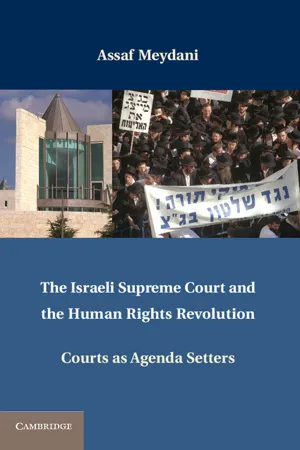
The Israeli Supreme Court and the Human Rights Revolution
Courts as Agenda Setters
- 224 pages
- English
- PDF
- Available on iOS & Android
eBook - PDF
About this book
This book explains the reciprocal relations between the Supreme Court and the Israeli political system. It is based on a unique approach that contends that the non-governability of the political system and an alternative political culture are two key formal and informal variables affecting the behavior of several political players within the Israeli arena. The analysis illustrates the usefulness of such a model for analyzing long-term socio-political processes and explaining the actions of the players. Until this model changes significantly, the decisions of the High Court of Justice express the values of the state and enable Israel to remain a nation that upholds human rights. The Court's decisions determine the normative educational direction and reflect Israel's democratic character with regard to the values of human rights.
Information
Table of contents
- Cover
- Title
- Copyright
- Contents
- Figures and Tables
- Acknowledgments
- 1 Introduction
- 2 The Intervention of the Israeli High Court of Justice in Government Decisions: An Empirical, Quantitative Study with Paradoxical Results
- 3 Law and Politics: Theoretical Aspects
- 4 The Supreme Court as a Political Entrepreneur in the Process of Institutional Change – an Analysis Based on Shared Mental Models and Political Entrepreneurship
- 5 Israeli Public Law
- 6 Israel in Light of Structural and Cultural Variables
- 7 The Supreme Court and the Political System in Light of Social and Political Processes in Israel during 1948–1999
- 8 The Struggle for a New Conservative Constitutional Court (2000): Redefining the Guarantor of Human Rights in Israel – the Role of the Israeli Supreme Court
- 9 The Rule of “Who Governs?” as Electoral Capital (1999–2007): The Supreme Court as an Agenda Setter in Israel
- 10 The Supreme Court of Israel as an Agenda Setter: Three Cases
- 11 On Law, Society, and Policy Design – toward a Reform in the Relationship between the High Court of Justice and the Knesset
- 12 Conclusion and Normative Implications
- Bibliography
- Index
Trusted by 375,005 students
Access to over 1.5 million titles for a fair monthly price.
Study more efficiently using our study tools.
Frequently asked questions
Yes, you can cancel anytime from the Subscription tab in your account settings on the Perlego website. Your subscription will stay active until the end of your current billing period. Learn how to cancel your subscription
No, books cannot be downloaded as external files, such as PDFs, for use outside of Perlego. However, you can download books within the Perlego app for offline reading on mobile or tablet. Learn how to download books offline
Perlego offers two plans: Essential and Complete
- Essential is ideal for learners and professionals who enjoy exploring a wide range of subjects. Access the Essential Library with 800,000+ trusted titles and best-sellers across business, personal growth, and the humanities. Includes unlimited reading time and Standard Read Aloud voice.
- Complete: Perfect for advanced learners and researchers needing full, unrestricted access. Unlock 1.5M+ books across hundreds of subjects, including academic and specialized titles. The Complete Plan also includes advanced features like Premium Read Aloud and Research Assistant.
We are an online textbook subscription service, where you can get access to an entire online library for less than the price of a single book per month. With over 1.5 million books across 990+ topics, we’ve got you covered! Learn about our mission
Look out for the read-aloud symbol on your next book to see if you can listen to it. The read-aloud tool reads text aloud for you, highlighting the text as it is being read. You can pause it, speed it up and slow it down. Learn more about Read Aloud
Yes! You can use the Perlego app on both iOS and Android devices to read anytime, anywhere — even offline. Perfect for commutes or when you’re on the go.
Please note we cannot support devices running on iOS 13 and Android 7 or earlier. Learn more about using the app
Please note we cannot support devices running on iOS 13 and Android 7 or earlier. Learn more about using the app
Yes, you can access The Israeli Supreme Court and the Human Rights Revolution by Assaf Meydani in PDF and/or ePUB format, as well as other popular books in Law & Public Law. We have over 1.5 million books available in our catalogue for you to explore.