eBook - PDF
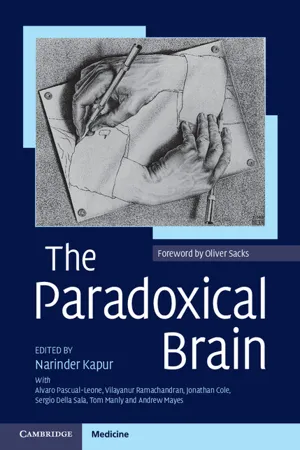
The Paradoxical Brain
- 490 pages
- English
- PDF
- Available on iOS & Android
eBook - PDF
The Paradoxical Brain
About this book
The Paradoxical Brain focuses on a range of phenomena in clinical and cognitive neuroscience that are counterintuitive and go against the grain of established thinking. The book covers a wide range of topics by leading researchers, including: • Superior performance after brain lesions or sensory loss • Return to normal function after a second brain lesion in neurological conditions • Paradoxical phenomena associated with human development • Examples where having one disease appears to prevent the occurrence of another disease • Situations where drugs with adverse effects on brain functioning may have beneficial effects in certain situations A better understanding of these interactions will lead to a better understanding of brain function and to the introduction of new therapeutic strategies. The book will be of interest to those working at the interface of brain and behaviour, including neuropsychologists, neurologists, psychiatrists and neuroscientists.
Information
Subtopic
NeuropsychologyIndex
PsychologyTable of contents
- Cover
- Half-title
- Title
- Copyright
- Contents
- Acknowledgements
- Preface
- Foreword
- Author affiliations
- Abbreviations
- Chapter 1 The paradoxical nature of nature
- Chapter 2 Paradoxical effects of sensory loss
- Chapter 3 Paradoxical functional facilitation and recovery in neurological and psychiatric conditions
- Chapter 4 Paradoxes in neurorehabilitation
- Chapter 5 The paradoxical self
- Chapter 6 Paradoxical psychological functioning in early child development
- Chapter 7 Cognitive ageing: a positive perspective
- Chapter 8 Paradoxes of learning and memory
- Chapter 9 The paradox of human expertise: why experts get it wrong
- Chapter 10 Paradoxes in Parkinson's disease and other movement disorders
- Chapter 11 Paradoxical phenomena in epilepsy
- Chapter 12 Paradoxical creativity and adjustment in neurological conditions
- Chapter 13 Paradoxical functional facilitation with noninvasive brain stimulation
- Chapter 14 Unexpected benefits of allergies and cigarette smoking: two examples of paradox in neuroepidemiology
- Chapter 15 The paradox of autism: why does disability sometimes give rise to talent?
- Chapter 16 Paradoxes in creativity and psychiatric conditions
- Chapter 17 The paradox of psychosurgery to treat mental disorders
- Chapter 18 The paradox of electroconvulsive therapy
- Chapter 19 Paradoxes of comparative cognition
- Chapter 20 Paradoxical phenomena in brain plasticity
- Chapter 21 Immature neurons in the adult brain. Breaking all the rules
- Chapter 22 The paradoxical hippocampus: when forgetting helps learning
- Chapter 23: Paradoxical effects of drugs on cognitive function: the neuropsychopharmacology of the dopamine and other neurotra smitter systems
- Chapter 24 The paradoxical brain - so what?
- Index
Trusted by 375,005 students
Access to over 1.5 million titles for a fair monthly price.
Study more efficiently using our study tools.
Frequently asked questions
Yes, you can cancel anytime from the Subscription tab in your account settings on the Perlego website. Your subscription will stay active until the end of your current billing period. Learn how to cancel your subscription
No, books cannot be downloaded as external files, such as PDFs, for use outside of Perlego. However, you can download books within the Perlego app for offline reading on mobile or tablet. Learn how to download books offline
Perlego offers two plans: Essential and Complete
- Essential is ideal for learners and professionals who enjoy exploring a wide range of subjects. Access the Essential Library with 800,000+ trusted titles and best-sellers across business, personal growth, and the humanities. Includes unlimited reading time and Standard Read Aloud voice.
- Complete: Perfect for advanced learners and researchers needing full, unrestricted access. Unlock 1.5M+ books across hundreds of subjects, including academic and specialized titles. The Complete Plan also includes advanced features like Premium Read Aloud and Research Assistant.
We are an online textbook subscription service, where you can get access to an entire online library for less than the price of a single book per month. With over 1.5 million books across 990+ topics, we’ve got you covered! Learn about our mission
Look out for the read-aloud symbol on your next book to see if you can listen to it. The read-aloud tool reads text aloud for you, highlighting the text as it is being read. You can pause it, speed it up and slow it down. Learn more about Read Aloud
Yes! You can use the Perlego app on both iOS and Android devices to read anytime, anywhere — even offline. Perfect for commutes or when you’re on the go.
Please note we cannot support devices running on iOS 13 and Android 7 or earlier. Learn more about using the app
Please note we cannot support devices running on iOS 13 and Android 7 or earlier. Learn more about using the app
Yes, you can access The Paradoxical Brain by Alvaro Pascual-Leone,Vilayanur Ramachandran,Jonathan Cole,Sergio Della Sala,Tom Manly,Andrew Mayes, Narinder Kapur in PDF and/or ePUB format, as well as other popular books in Psychology & Neuropsychology. We have over 1.5 million books available in our catalogue for you to explore.