- 226 pages
- English
- PDF
- Available on iOS & Android
eBook - PDF
About this book
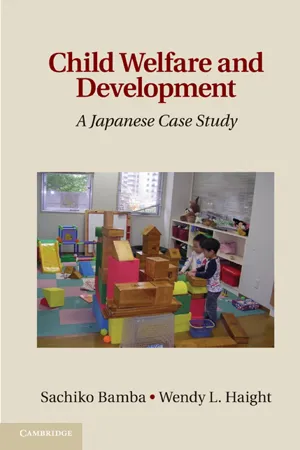
Bamba and Haight provide an in-depth understanding of the everyday experiences and perspectives of maltreated children and their substitute caregivers and teachers in Japan. Their innovative research program combines strategies from developmental psychology, ethnography and action research. Although child advocates from around the world share certain goals and challenges, there is substantial cultural variation in how child maltreatment is understood, its origins, impact on children and families, as well as societal responses deemed appropriate. The authors step outside of the Western cultural context to illustrate creative ecologically and developmentally based strategies for supporting the psychosocial well-being of maltreated children in state care, provide an alternative but complementary model to the prevalent large-scale survey strategies for conducting international research in child welfare, and provide a resource for educators to enhance the international content of human development, education, social work and child welfare courses.
Information
Table of contents
- Cover
- Title
- Copyright
- Contents
- Tables and figures
- Acknowledgments
- 1. Child-rearing at a Residential Child Care Institution: Watching with Long Eyes
- 2. Japanese Contexts and Concepts: Jidou Yougo Shisetsu, Ibasho, and Mimamori
- 3. The Research Program
- 4. A Developmental Goal for Maltreated Children: Ibasho Creation
- 5. Challenges to Maltreated Children’s Ibasho Creation
- 6. Socialization Practices Underlying Ibasho Creation: Mimamori
- 7. Children’s Lives and Experiences of Ibasho and Mimamori
- 8. Mr. Watanabe’s Responses to the Intervention
- 9. Reflections on Some Challenges of Field Research
- 10. The Emerging Child Welfare Context of Jidou Yougo Shisetsu
- 11. Conclusion: Some Lessons for Culturally Sensitive Child Welfare
- References
- Index
Trusted by 375,005 students
Access to over 1.5 million titles for a fair monthly price.
Study more efficiently using our study tools.
Frequently asked questions
Yes, you can cancel anytime from the Subscription tab in your account settings on the Perlego website. Your subscription will stay active until the end of your current billing period. Learn how to cancel your subscription
No, books cannot be downloaded as external files, such as PDFs, for use outside of Perlego. However, you can download books within the Perlego app for offline reading on mobile or tablet. Learn how to download books offline
Perlego offers two plans: Essential and Complete
- Essential is ideal for learners and professionals who enjoy exploring a wide range of subjects. Access the Essential Library with 800,000+ trusted titles and best-sellers across business, personal growth, and the humanities. Includes unlimited reading time and Standard Read Aloud voice.
- Complete: Perfect for advanced learners and researchers needing full, unrestricted access. Unlock 1.5M+ books across hundreds of subjects, including academic and specialized titles. The Complete Plan also includes advanced features like Premium Read Aloud and Research Assistant.
We are an online textbook subscription service, where you can get access to an entire online library for less than the price of a single book per month. With over 1.5 million books across 990+ topics, we’ve got you covered! Learn about our mission
Look out for the read-aloud symbol on your next book to see if you can listen to it. The read-aloud tool reads text aloud for you, highlighting the text as it is being read. You can pause it, speed it up and slow it down. Learn more about Read Aloud
Yes! You can use the Perlego app on both iOS and Android devices to read anytime, anywhere — even offline. Perfect for commutes or when you’re on the go.
Please note we cannot support devices running on iOS 13 and Android 7 or earlier. Learn more about using the app
Please note we cannot support devices running on iOS 13 and Android 7 or earlier. Learn more about using the app
Yes, you can access Child Welfare and Development by Sachiko Bamba,Wendy L. Haight in PDF and/or ePUB format, as well as other popular books in Psychology & Developmental Psychology. We have over 1.5 million books available in our catalogue for you to explore.