- 274 pages
- English
- PDF
- Available on iOS & Android
eBook - PDF
About this book
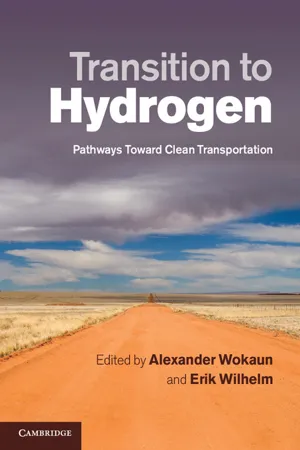
This book is a comprehensive and objective guide to understanding hydrogen as a transportation fuel. The effects that pursuing different vehicle technology development paths will have on the economy, the environment, public safety and human health are presented with implications for policy makers, industrial stakeholders and researchers alike. Using hydrogen as a fuel offers a possible solution to satisfying global mobility needs, including sustainability of supply and the potential reduction of greenhouse gas emissions. This book focuses on research issues that are at the intersection of hydrogen and transportation, since the study of vehicles and energy-carriers is inseparable. It concentrates on light duty vehicles (cars and light trucks), set in the context of other competing technologies, the larger energy sector and the overall economy. The book is invaluable for researchers and policy makers in transportation policy, energy economics, systems dynamics, vehicle powertrain modeling and simulation, environmental science and environmental engineering.
Information
Table of contents
- Cover
- Title
- Copyright
- Contents
- List of Contributors
- Foreword: on the transition to hydrogen
- Preface
- Executive summary
- Abbreviations
- 1 Introduction
- 2 Life cycle assessment of hydrogen production
- 3 Technical characterisation and multi-criteriaanalysis of light-duty vehicles
- 4 Hydrogen emissions to the atmosphere from industry and transportation
- 5 Regional fleet simulation
- 6 Long-term scenarios of the global energy and transport system
- 7 Integrated assessment of hydrogen in transportation
- Appendix A Summary of fundamental assumptions
- Appendix B Selected input assumptions, technology descriptions, and heuristics
- Appendix C Characteristics of the present andfuture vehicle designs
- Appendix D Survey questionnaire and aggregated responses
- Appendix E Assumptions and inputs drivingfleet dynamics simulation
- References
- Index
Trusted by 375,005 students
Access to over 1.5 million titles for a fair monthly price.
Study more efficiently using our study tools.
Frequently asked questions
Yes, you can cancel anytime from the Subscription tab in your account settings on the Perlego website. Your subscription will stay active until the end of your current billing period. Learn how to cancel your subscription
No, books cannot be downloaded as external files, such as PDFs, for use outside of Perlego. However, you can download books within the Perlego app for offline reading on mobile or tablet. Learn how to download books offline
Perlego offers two plans: Essential and Complete
- Essential is ideal for learners and professionals who enjoy exploring a wide range of subjects. Access the Essential Library with 800,000+ trusted titles and best-sellers across business, personal growth, and the humanities. Includes unlimited reading time and Standard Read Aloud voice.
- Complete: Perfect for advanced learners and researchers needing full, unrestricted access. Unlock 1.5M+ books across hundreds of subjects, including academic and specialized titles. The Complete Plan also includes advanced features like Premium Read Aloud and Research Assistant.
We are an online textbook subscription service, where you can get access to an entire online library for less than the price of a single book per month. With over 1.5 million books across 990+ topics, we’ve got you covered! Learn about our mission
Look out for the read-aloud symbol on your next book to see if you can listen to it. The read-aloud tool reads text aloud for you, highlighting the text as it is being read. You can pause it, speed it up and slow it down. Learn more about Read Aloud
Yes! You can use the Perlego app on both iOS and Android devices to read anytime, anywhere — even offline. Perfect for commutes or when you’re on the go.
Please note we cannot support devices running on iOS 13 and Android 7 or earlier. Learn more about using the app
Please note we cannot support devices running on iOS 13 and Android 7 or earlier. Learn more about using the app
Yes, you can access Transition to Hydrogen by Alexander Wokaun,Erik Wilhelm in PDF and/or ePUB format, as well as other popular books in Law & Environmental Law. We have over 1.5 million books available in our catalogue for you to explore.