- 308 pages
- English
- PDF
- Available on iOS & Android
eBook - PDF
About this book
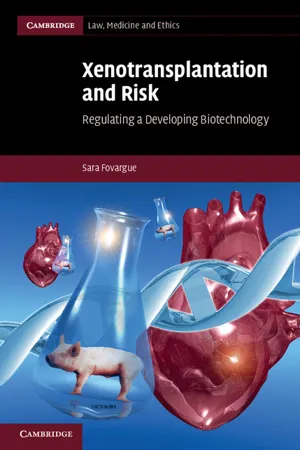
Some developing biotechnologies challenge accepted legal and ethical norms because of the risks they pose. Xenotransplantation (cross-species transplantation) may prolong life but may also harm the xeno-recipient and the public due to its potential to transmit infectious diseases. These trans-boundary diseases emphasise the global nature of advances in health care and highlight the difficulties of identifying, monitoring and regulating such risks and thereby protecting individual and public health. Xenotransplantation raises questions about how uncertainty and risk are understood and accepted, and exposes tensions between private benefit and public health. Where public health is at risk, a precautionary approach informed by the harm principle supports prioritising the latter, but the issues raised by genetically engineered solid organ xenotransplants have not, as yet, been sufficiently discussed. This must occur prior to their clinical introduction because of the necessary changes to accepted norms which are needed to appropriately safeguard individual and public health.
Information
Topic
DirittoSubtopic
Diritto medicoTable of contents
- Cover
- Xenotransplantation and Risk
- Cambridge Law, Medicine and Ethics
- Title
- Copyright
- Dedication
- Contents
- Acknowledgements
- 1 Introducing the issues
- 2 Dealing with risk
- 3 Regulating experimental procedures and medical research
- 4 Regulatory responses to developing biotechnologies
- 5 Challenges to legal and ethical norms: first-party consent and third parties at risk
- 6 Surveillance and monitoring: balancing public health and individual freedom
- 7 Summary and concluding thoughts: looking to the future
- Bibliography
- Index
Trusted by 375,005 students
Access to over 1.5 million titles for a fair monthly price.
Study more efficiently using our study tools.
Frequently asked questions
Yes, you can cancel anytime from the Subscription tab in your account settings on the Perlego website. Your subscription will stay active until the end of your current billing period. Learn how to cancel your subscription
No, books cannot be downloaded as external files, such as PDFs, for use outside of Perlego. However, you can download books within the Perlego app for offline reading on mobile or tablet. Learn how to download books offline
Perlego offers two plans: Essential and Complete
- Essential is ideal for learners and professionals who enjoy exploring a wide range of subjects. Access the Essential Library with 800,000+ trusted titles and best-sellers across business, personal growth, and the humanities. Includes unlimited reading time and Standard Read Aloud voice.
- Complete: Perfect for advanced learners and researchers needing full, unrestricted access. Unlock 1.5M+ books across hundreds of subjects, including academic and specialized titles. The Complete Plan also includes advanced features like Premium Read Aloud and Research Assistant.
We are an online textbook subscription service, where you can get access to an entire online library for less than the price of a single book per month. With over 1.5 million books across 990+ topics, we’ve got you covered! Learn about our mission
Look out for the read-aloud symbol on your next book to see if you can listen to it. The read-aloud tool reads text aloud for you, highlighting the text as it is being read. You can pause it, speed it up and slow it down. Learn more about Read Aloud
Yes! You can use the Perlego app on both iOS and Android devices to read anytime, anywhere — even offline. Perfect for commutes or when you’re on the go.
Please note we cannot support devices running on iOS 13 and Android 7 or earlier. Learn more about using the app
Please note we cannot support devices running on iOS 13 and Android 7 or earlier. Learn more about using the app
Yes, you can access Xenotransplantation and Risk by Sara Fovargue in PDF and/or ePUB format, as well as other popular books in Diritto & Diritto medico. We have over 1.5 million books available in our catalogue for you to explore.