- 368 pages
- English
- PDF
- Available on iOS & Android
eBook - PDF
About this book
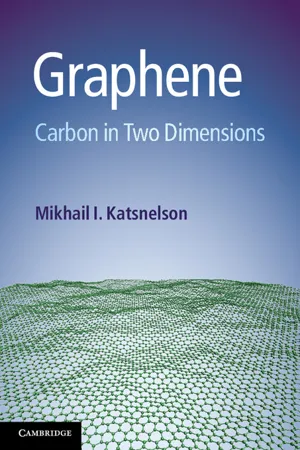
Graphene is the thinnest known material, a sheet of carbon atoms arranged in hexagonal cells a single atom thick, and yet stronger than diamond. It has potentially significant applications in nanotechnology, 'beyond-silicon' electronics, solid-state realization of high-energy phenomena and as a prototype membrane which could revolutionise soft matter and 2D physics. In this book, leading graphene research theorist Mikhail Katsnelson presents the basic concepts of graphene physics. Topics covered include Berry phase, topologically protected zero modes, Klein tunneling, vacuum reconstruction near supercritical charges, and deformation-induced gauge fields. The book also introduces the theory of flexible membranes relevant to graphene physics and discusses electronic transport, optical properties, magnetism and spintronics. Standard undergraduate-level knowledge of quantum and statistical physics and solid state theory is assumed. This is an important textbook for graduate students in nanoscience and nanotechnology and an excellent introduction for physicists and materials science researchers working in related areas.
Information
Table of contents
- Cover
- GRAPHENE
- Title
- Copyright
- Dedication
- Contents
- Preface
- 1: The electronic structure of ideal graphene
- 2: Electron states in a magnetic field
- 3: Quantum transport via evanescent waves
- 4: The Klein paradox and chiral tunnelling
- 5: Edges, nanoribbons and quantum dots
- 6: Point defects
- 7: Optics and response functions
- 8: The Coulomb problem
- 9: Crystal lattice dynamics, structure and thermodynamics
- 10: Gauge fields and strain engineering
- 11: Scattering mechanisms and transport properties
- 12: Spin effects and magnetism
- References
- Index
Trusted by 375,005 students
Access to over 1.5 million titles for a fair monthly price.
Study more efficiently using our study tools.
Frequently asked questions
Yes, you can cancel anytime from the Subscription tab in your account settings on the Perlego website. Your subscription will stay active until the end of your current billing period. Learn how to cancel your subscription
No, books cannot be downloaded as external files, such as PDFs, for use outside of Perlego. However, you can download books within the Perlego app for offline reading on mobile or tablet. Learn how to download books offline
Perlego offers two plans: Essential and Complete
- Essential is ideal for learners and professionals who enjoy exploring a wide range of subjects. Access the Essential Library with 800,000+ trusted titles and best-sellers across business, personal growth, and the humanities. Includes unlimited reading time and Standard Read Aloud voice.
- Complete: Perfect for advanced learners and researchers needing full, unrestricted access. Unlock 1.5M+ books across hundreds of subjects, including academic and specialized titles. The Complete Plan also includes advanced features like Premium Read Aloud and Research Assistant.
We are an online textbook subscription service, where you can get access to an entire online library for less than the price of a single book per month. With over 1.5 million books across 990+ topics, we’ve got you covered! Learn about our mission
Look out for the read-aloud symbol on your next book to see if you can listen to it. The read-aloud tool reads text aloud for you, highlighting the text as it is being read. You can pause it, speed it up and slow it down. Learn more about Read Aloud
Yes! You can use the Perlego app on both iOS and Android devices to read anytime, anywhere — even offline. Perfect for commutes or when you’re on the go.
Please note we cannot support devices running on iOS 13 and Android 7 or earlier. Learn more about using the app
Please note we cannot support devices running on iOS 13 and Android 7 or earlier. Learn more about using the app
Yes, you can access Graphene by Mikhail I. Katsnelson in PDF and/or ePUB format, as well as other popular books in Physical Sciences & Physics. We have over 1.5 million books available in our catalogue for you to explore.