- 592 pages
- English
- PDF
- Available on iOS & Android
eBook - PDF
About this book
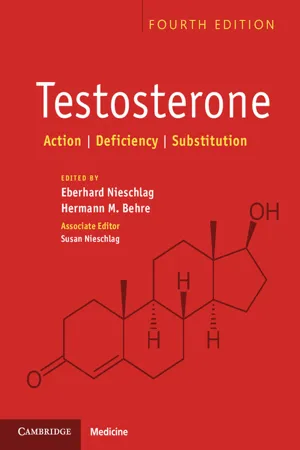
Now in its fourth edition Testosterone: Action, Deficiency, Substitution provides the most up-to-date and comprehensive source of information on testosterone and its role in human physiology and pathology. It covers biosynthesis and mechanisms of action and reviews their effects on brain and behavior, spermatogenesis, hair growth, bones, muscles, erythropoiesis, the cardiovascular system and the prostate. The therapeutic uses of testosterone preparations are carefully evaluated as well as its abuse and detection in competitive sport. This new edition also devotes sections to exploring the effects of testosterone on female physiology and sexual function, and the experimental use of testosterone in male hormonal contraception. Testosterone: Action, Deficiency, Substitution has been written and edited by world experts in the fields of clinical andrology and endocrinology and provides a unique and invaluable guide for andrologists, endocrinologists, urologists, internists and those working in reproductive medicine.
Information
Table of contents
- Cover
- Testosterone: Action, Deficiency, Substitution: Fourth Edition
- Title
- Copyright
- Contents
- Contributors
- Preface
- Chapter 1 The medical and cultural history of testosterone and the testes
- Chapter 2 Testosterone: biosynthesis, transport, metabolism and (non-genomic) actions
- Chapter 3 Pathophysiology of the androgen receptor
- Chapter 4 Methodology for measuring testosterone, dihydrotestosterone and sex hormone-binding globulin in a clinical setting
- Chapter 5 The behavioral correlates of testosterone
- Chapter 6 The role of testosterone in spermatogenesis
- Chapter 7 Androgens and hair: a biological paradox with clinical consequences
- Chapter 8 Testosterone and bone
- Chapter 9 Androgen effects on the skeletal muscle
- Chapter 10 Testosterone and cardiovascular disease
- Chapter 11 Testosterone, obesity, diabetes and the metabolic syndrome
- Chapter 12 Testosterone and erection
- Chapter 13 Testosterone and the prostate
- Chapter 14 Clinical use of testosterone in hypogonadism and other conditions
- Chapter 15 Testosterone preparations for clinical use in males
- Chapter 16 Androgens in male senescence
- Chapter 17 Androgen therapy in non-gonadal disease
- Chapter 18 Review of guidelines on diagnosis and treatment of testosterone deficiency
- Chapter 19 Pathophysiology of estrogen action in men
- Chapter 20 Dehydroepiandrosterone and androstenedione
- Chapter 21 The state-of-the-art in the development of selective androgen receptor modulators
- Chapter 22 The essential role of testosterone in hormonal male contraception
- Chapter 23 Testosterone use in women
- Chapter 24 Detection of illegal use of androgens and selective androgen receptor modulators
- Chapter 25 Sequelae of doping with anabolic steroids
- Index
Trusted by 375,005 students
Access to over 1.5 million titles for a fair monthly price.
Study more efficiently using our study tools.
Frequently asked questions
Yes, you can cancel anytime from the Subscription tab in your account settings on the Perlego website. Your subscription will stay active until the end of your current billing period. Learn how to cancel your subscription
No, books cannot be downloaded as external files, such as PDFs, for use outside of Perlego. However, you can download books within the Perlego app for offline reading on mobile or tablet. Learn how to download books offline
Perlego offers two plans: Essential and Complete
- Essential is ideal for learners and professionals who enjoy exploring a wide range of subjects. Access the Essential Library with 800,000+ trusted titles and best-sellers across business, personal growth, and the humanities. Includes unlimited reading time and Standard Read Aloud voice.
- Complete: Perfect for advanced learners and researchers needing full, unrestricted access. Unlock 1.5M+ books across hundreds of subjects, including academic and specialized titles. The Complete Plan also includes advanced features like Premium Read Aloud and Research Assistant.
We are an online textbook subscription service, where you can get access to an entire online library for less than the price of a single book per month. With over 1.5 million books across 990+ topics, we’ve got you covered! Learn about our mission
Look out for the read-aloud symbol on your next book to see if you can listen to it. The read-aloud tool reads text aloud for you, highlighting the text as it is being read. You can pause it, speed it up and slow it down. Learn more about Read Aloud
Yes! You can use the Perlego app on both iOS and Android devices to read anytime, anywhere — even offline. Perfect for commutes or when you’re on the go.
Please note we cannot support devices running on iOS 13 and Android 7 or earlier. Learn more about using the app
Please note we cannot support devices running on iOS 13 and Android 7 or earlier. Learn more about using the app
Yes, you can access Testosterone by Eberhard Nieschlag,Hermann M. Behre in PDF and/or ePUB format, as well as other popular books in Medicine & Gynecology, Obstetrics & Midwifery. We have over 1.5 million books available in our catalogue for you to explore.