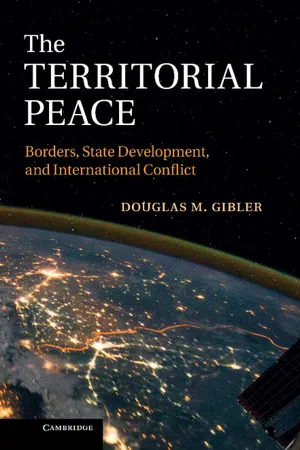
eBook - PDF
The Territorial Peace
Borders, State Development, and International Conflict
- 206 pages
- English
- PDF
- Available on iOS & Android
eBook - PDF
About this book
There is continued discussion in International Relations surrounding the existence (or not) of the 'democratic peace' - the idea that democracies do not fight each other. This book argues that threats to homeland territories force centralization within the state, for three reasons. First, territorial threats are highly salient to individuals, and leaders must respond by promoting the security of the state. Second, threatened territories must be defended by large, standing land armies and these armies can then be used as forces for repression during times of peace. Finally, domestic political bargaining is dramatically altered during times of territorial threat, with government opponents joining the leader in promoting the security of the state. Leaders therefore have a favorable environment in which to institutionalize greater executive power. These forces explain why conflicts are associated with centralized states, and in turn why peace is associated with democracy.
Information
Table of contents
- Cover
- The Territorial Peace
- Title
- Copyright
- Dedication
- Contents
- Illustrations
- Tables
- Acknowledgments
- 1 Introduction
- PART I International borders
- Part II State development
- Part III The territorial peace
Trusted by 375,005 students
Access to over 1.5 million titles for a fair monthly price.
Study more efficiently using our study tools.
Frequently asked questions
Yes, you can cancel anytime from the Subscription tab in your account settings on the Perlego website. Your subscription will stay active until the end of your current billing period. Learn how to cancel your subscription
No, books cannot be downloaded as external files, such as PDFs, for use outside of Perlego. However, you can download books within the Perlego app for offline reading on mobile or tablet. Learn how to download books offline
We are an online textbook subscription service, where you can get access to an entire online library for less than the price of a single book per month. With over 1.5 million books across 990+ topics, we’ve got you covered! Learn about our mission
Look out for the read-aloud symbol on your next book to see if you can listen to it. The read-aloud tool reads text aloud for you, highlighting the text as it is being read. You can pause it, speed it up and slow it down. Learn more about Read Aloud
Yes! You can use the Perlego app on both iOS and Android devices to read anytime, anywhere — even offline. Perfect for commutes or when you’re on the go.
Please note we cannot support devices running on iOS 13 and Android 7 or earlier. Learn more about using the app
Please note we cannot support devices running on iOS 13 and Android 7 or earlier. Learn more about using the app
Yes, you can access The Territorial Peace by Douglas M. Gibler in PDF and/or ePUB format, as well as other popular books in Politics & International Relations & International Relations. We have over 1.5 million books available in our catalogue for you to explore.