eBook - PDF
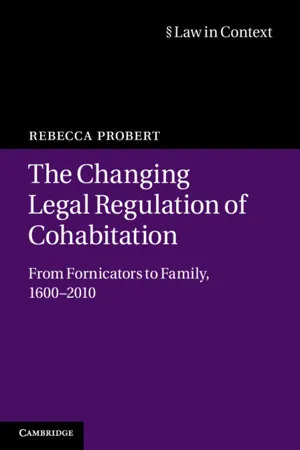
The Changing Legal Regulation of Cohabitation
From Fornicators to Family, 1600–2010
- 302 pages
- English
- PDF
- Available on iOS & Android
eBook - PDF
About this book
This book has three key aims: first, to show how the legal treatment of cohabiting couples has changed over the past four centuries, from punishment as fornicators in the seventeenth century to eventual acceptance as family in the late twentieth; second, to chart how the language used to refer to cohabitation has changed over time and how different terms influenced policy debates and public perceptions; and, third, to estimate the extent of cohabitation in earlier centuries. To achieve this it draws on hundreds of reported and unreported cases as well as legislation, policy papers and debates in Parliament; thousands of newspaper reports and magazine articles; and innovative cohort studies that provide new and more reliable evidence as to the incidence (or rather the rarity) of cohabitation in eighteenth- and nineteenth-century England. It concludes with a consideration of the relationship between legal regulation and social trends.
Information
Table of contents
- Cover
- The Changing Legal Regulation of Cohabitation
- Series
- Title
- Copyright
- Contents
- Figures
- Acknowledgements
- 1 Introduction
- 2 ‘Fornicators’: the punishment of illicit sex,1600–1760s
- 3 No Name: law, morality and precedent in the long nineteenth century, 1770s–1900
- 4 ‘Unmarried wives’ in war and peace, 1900–1927
- 5 ‘Living in sin’: concerns and changes,1928–1963
- 6 ‘Stable illicit unions’: cohabitation andthe reform of divorce, 1963–1972
- 7 ‘Common-law wives’: the creation ofthe myth, 1973–1979
- 8 ‘Live-in lovers’: under the Tories,1979–1997
- 9 ‘Partners’: New Labour and neutrality, 1997–2010
- 10 Conclusion
- Index
Trusted by 375,005 students
Access to over 1.5 million titles for a fair monthly price.
Study more efficiently using our study tools.
Frequently asked questions
Yes, you can cancel anytime from the Subscription tab in your account settings on the Perlego website. Your subscription will stay active until the end of your current billing period. Learn how to cancel your subscription
No, books cannot be downloaded as external files, such as PDFs, for use outside of Perlego. However, you can download books within the Perlego app for offline reading on mobile or tablet. Learn how to download books offline
Perlego offers two plans: Essential and Complete
- Essential is ideal for learners and professionals who enjoy exploring a wide range of subjects. Access the Essential Library with 800,000+ trusted titles and best-sellers across business, personal growth, and the humanities. Includes unlimited reading time and Standard Read Aloud voice.
- Complete: Perfect for advanced learners and researchers needing full, unrestricted access. Unlock 1.5M+ books across hundreds of subjects, including academic and specialized titles. The Complete Plan also includes advanced features like Premium Read Aloud and Research Assistant.
We are an online textbook subscription service, where you can get access to an entire online library for less than the price of a single book per month. With over 1.5 million books across 990+ topics, we’ve got you covered! Learn about our mission
Look out for the read-aloud symbol on your next book to see if you can listen to it. The read-aloud tool reads text aloud for you, highlighting the text as it is being read. You can pause it, speed it up and slow it down. Learn more about Read Aloud
Yes! You can use the Perlego app on both iOS and Android devices to read anytime, anywhere — even offline. Perfect for commutes or when you’re on the go.
Please note we cannot support devices running on iOS 13 and Android 7 or earlier. Learn more about using the app
Please note we cannot support devices running on iOS 13 and Android 7 or earlier. Learn more about using the app
Yes, you can access The Changing Legal Regulation of Cohabitation by Rebecca Probert in PDF and/or ePUB format, as well as other popular books in Law & Family Law. We have over 1.5 million books available in our catalogue for you to explore.