- 296 pages
- English
- PDF
- Available on iOS & Android
eBook - PDF
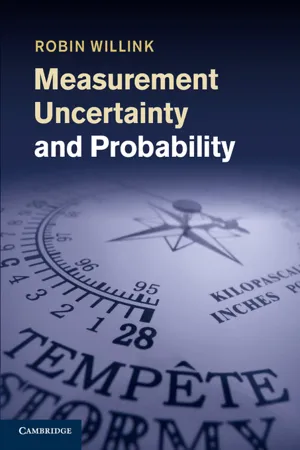
Measurement Uncertainty and Probability
About this book
A measurement result is incomplete without a statement of its 'uncertainty' or 'margin of error'. But what does this statement actually tell us? By examining the practical meaning of probability, this book discusses what is meant by a '95 percent interval of measurement uncertainty', and how such an interval can be calculated. The book argues that the concept of an unknown 'target value' is essential if probability is to be used as a tool for evaluating measurement uncertainty. It uses statistical concepts, such as a conditional confidence interval, to present 'extended' classical methods for evaluating measurement uncertainty. The use of the Monte Carlo principle for the simulation of experiments is described. Useful for researchers and graduate students, the book also discusses other philosophies relating to the evaluation of measurement uncertainty. It employs clear notation and language to avoid the confusion that exists in this controversial field of science.
Information
Table of contents
- Cover
- Contents
- Acknowledgements
- Introduction
- Part I Principles
- Part II Evaluation of uncertainty
- Part III Related topics
- Appendix A The weak law of large numbers
- Appendix B The Sleeping Beauty paradox
- Appendix C The sum of normal and uniform variates
- Appendix D Analysis with one Type A and one Type B error
- Appendix E Conservatism of treatment of Type A errors
- Appendix F An alternative to a symmetric beta distribution
- Appendix G Dimensions of the ellipsoidal confidence region
- Appendix H Derivation of the Feldman–Cousins interval
- References
- Index
Trusted by 375,005 students
Access to over 1.5 million titles for a fair monthly price.
Study more efficiently using our study tools.
Frequently asked questions
Yes, you can cancel anytime from the Subscription tab in your account settings on the Perlego website. Your subscription will stay active until the end of your current billing period. Learn how to cancel your subscription
No, books cannot be downloaded as external files, such as PDFs, for use outside of Perlego. However, you can download books within the Perlego app for offline reading on mobile or tablet. Learn how to download books offline
We are an online textbook subscription service, where you can get access to an entire online library for less than the price of a single book per month. With over 1.5 million books across 990+ topics, we’ve got you covered! Learn about our mission
Look out for the read-aloud symbol on your next book to see if you can listen to it. The read-aloud tool reads text aloud for you, highlighting the text as it is being read. You can pause it, speed it up and slow it down. Learn more about Read Aloud
Yes! You can use the Perlego app on both iOS and Android devices to read anytime, anywhere — even offline. Perfect for commutes or when you’re on the go.
Please note we cannot support devices running on iOS 13 and Android 7 or earlier. Learn more about using the app
Please note we cannot support devices running on iOS 13 and Android 7 or earlier. Learn more about using the app
Yes, you can access Measurement Uncertainty and Probability by Robin Willink in PDF and/or ePUB format, as well as other popular books in Physical Sciences & Physics. We have over 1.5 million books available in our catalogue for you to explore.