eBook - PDF
From Philology to English Studies
Language and Culture in the Nineteenth Century
- 242 pages
- English
- PDF
- Available on iOS & Android
eBook - PDF
About this book
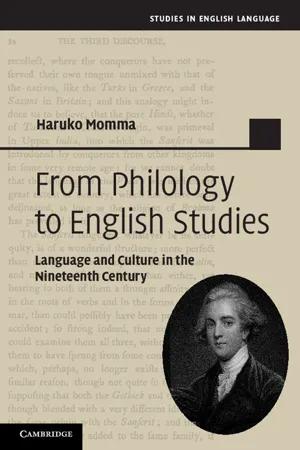
The study of English language and literature in Britain changed dramatically between the end of the eighteenth century and the beginning of the twentieth. From Philology to English Studies explores the contribution of philology to this movement. Haruko Momma charts both the rise and fall of philology from antiquity to the late eighteenth century, and the impact of modern philology on the study of modern languages and literatures. Focusing in detail on the work of key philologists in the nineteenth century, Momma considers how they shaped European discourse and especially vernacular studies in Britain: William Jones's discovery of Sanskrit in British India gave rise to Indo-European studies; Max Müller's study of this same language helped spread the Aryan myth to the English-speaking world; the OED achieved its greatness as a post-national lexicon under the editorship of James Murray, a dialectologist originally from Scotland.
Information
Table of contents
- Cover
- From Philology to English Studies
- Title
- Copyright
- Dedication
- Contents
- Preface
- 1 Introduction: where is philology?
- 2 Philological awakening: William Jonesand the architecture of learning
- 3 The Anglo-Saxon revolution: John Mitchell Kemble and the paradigm
- 4 The Philological Society of London: lexicography as national philology
- 5 The professor and the reader: vernaculars in the academy
- Epilogue: the closing of the phase of philology
- Bibliography
- Index
Trusted by 375,005 students
Access to over 1.5 million titles for a fair monthly price.
Study more efficiently using our study tools.
Frequently asked questions
Yes, you can cancel anytime from the Subscription tab in your account settings on the Perlego website. Your subscription will stay active until the end of your current billing period. Learn how to cancel your subscription
No, books cannot be downloaded as external files, such as PDFs, for use outside of Perlego. However, you can download books within the Perlego app for offline reading on mobile or tablet. Learn how to download books offline
Perlego offers two plans: Essential and Complete
- Essential is ideal for learners and professionals who enjoy exploring a wide range of subjects. Access the Essential Library with 800,000+ trusted titles and best-sellers across business, personal growth, and the humanities. Includes unlimited reading time and Standard Read Aloud voice.
- Complete: Perfect for advanced learners and researchers needing full, unrestricted access. Unlock 1.5M+ books across hundreds of subjects, including academic and specialized titles. The Complete Plan also includes advanced features like Premium Read Aloud and Research Assistant.
We are an online textbook subscription service, where you can get access to an entire online library for less than the price of a single book per month. With over 1.5 million books across 990+ topics, we’ve got you covered! Learn about our mission
Look out for the read-aloud symbol on your next book to see if you can listen to it. The read-aloud tool reads text aloud for you, highlighting the text as it is being read. You can pause it, speed it up and slow it down. Learn more about Read Aloud
Yes! You can use the Perlego app on both iOS and Android devices to read anytime, anywhere — even offline. Perfect for commutes or when you’re on the go.
Please note we cannot support devices running on iOS 13 and Android 7 or earlier. Learn more about using the app
Please note we cannot support devices running on iOS 13 and Android 7 or earlier. Learn more about using the app
Yes, you can access From Philology to English Studies by Haruko Momma in PDF and/or ePUB format, as well as other popular books in Languages & Linguistics & Historical & Comparative Linguistics. We have over 1.5 million books available in our catalogue for you to explore.