- 252 pages
- English
- PDF
- Available on iOS & Android
eBook - PDF
Representing Space in the Scientific Revolution
About this book
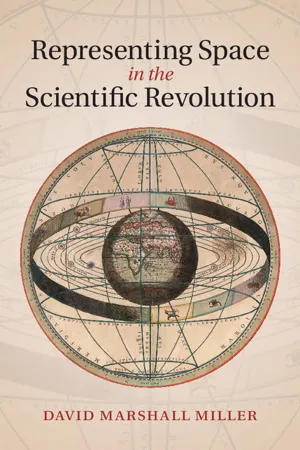
The novel understanding of the physical world that characterized the Scientific Revolution depended on a fundamental shift in the way its protagonists understood and described space. At the beginning of the seventeenth century, spatial phenomena were described in relation to a presupposed central point; by its end, space had become a centerless void in which phenomena could only be described by reference to arbitrary orientations. David Marshall Miller examines both the historical and philosophical aspects of this far-reaching development, including the rejection of the idea of heavenly spheres, the advent of rectilinear inertia, and the theoretical contributions of Copernicus, Gilbert, Kepler, Galileo, Descartes, and Newton. His rich study shows clearly how the centered Aristotelian cosmos became the oriented Newtonian universe, and will be of great interest to students and scholars of the history and philosophy of science.
Information
Topic
PhilosophySubtopic
Modern PhilosophyTable of contents
- Cover
- Half-title page
- Title page
- Copyright page
- Dedication
- Contents
- Figures
- Preface
- Note on texts
- Chapter 1 Introduction: centers and orientations
- Chapter 2 Pluribus ergo existentibus centris: explanations, descriptions, and Copernicus
- Chapter 3 Non est motus omnino: Gilbert, verticity, and the Law of the Whole
- Chapter 4 Respicere sinus: Kepler, oriented space, and the ellipse
- Chapter 5 Mille movimenti circolari: from impetus to conserved curvilinear motion in Galileo
- Chapter 6 Directions sont entre elles paralleles: Descartes and his critics on oriented space and the parallelogram rule
- Chapter 7 Incline it to verge: Newton’s spatial synthesis
- Chapter 8 Conclusion: methodological morals
- References
- Index
Trusted by 375,005 students
Access to over 1.5 million titles for a fair monthly price.
Study more efficiently using our study tools.
Frequently asked questions
Yes, you can cancel anytime from the Subscription tab in your account settings on the Perlego website. Your subscription will stay active until the end of your current billing period. Learn how to cancel your subscription
No, books cannot be downloaded as external files, such as PDFs, for use outside of Perlego. However, you can download books within the Perlego app for offline reading on mobile or tablet. Learn how to download books offline
Perlego offers two plans: Essential and Complete
- Essential is ideal for learners and professionals who enjoy exploring a wide range of subjects. Access the Essential Library with 800,000+ trusted titles and best-sellers across business, personal growth, and the humanities. Includes unlimited reading time and Standard Read Aloud voice.
- Complete: Perfect for advanced learners and researchers needing full, unrestricted access. Unlock 1.5M+ books across hundreds of subjects, including academic and specialized titles. The Complete Plan also includes advanced features like Premium Read Aloud and Research Assistant.
We are an online textbook subscription service, where you can get access to an entire online library for less than the price of a single book per month. With over 1.5 million books across 990+ topics, we’ve got you covered! Learn about our mission
Look out for the read-aloud symbol on your next book to see if you can listen to it. The read-aloud tool reads text aloud for you, highlighting the text as it is being read. You can pause it, speed it up and slow it down. Learn more about Read Aloud
Yes! You can use the Perlego app on both iOS and Android devices to read anytime, anywhere — even offline. Perfect for commutes or when you’re on the go.
Please note we cannot support devices running on iOS 13 and Android 7 or earlier. Learn more about using the app
Please note we cannot support devices running on iOS 13 and Android 7 or earlier. Learn more about using the app
Yes, you can access Representing Space in the Scientific Revolution by David Marshall Miller in PDF and/or ePUB format, as well as other popular books in Philosophy & Modern Philosophy. We have over 1.5 million books available in our catalogue for you to explore.