- 212 pages
- English
- PDF
- Available on iOS & Android
eBook - PDF
Popular Literature, Authorship and the Occult in Late Victorian Britain
About this book
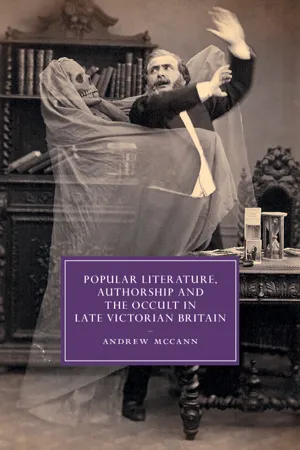
With the increasing commercialization of publishing at the end of the nineteenth century, the polarization of serious literature and popular fiction became a commonplace of literary criticism. Andrew McCann cautions against this opposition by arguing that popular fiction's engagement with heterodox conceptions of authorship and creativity complicates its status as mere distraction or entertainment. Popular writers such as George Du Maurier, Marie Corelli, Rosa Praed and Arthur Machen drew upon a contemporary fascination with occult practices to construct texts that had an intensely ambiguous relationship to the proprietary notions of authorship that were so central to commercial publishing. Through trance-induced or automatic writing, dream states, dual personality and the retrieval of past lives channeled through mediums, they imagined forms of authorship that reinvested popular texts with claims to aesthetic and political value that cut against the homogenizing pressures of an emerging culture industry.
Information
Table of contents
- Cover
- Half-title page
- Series page
- Title page
- Copyright page
- Contents
- Acknowledgements
- Introduction: Popular fiction as media histrionics
- Chapter 1 Property, professionalism and the pathologies of literature: Walter Besant and the discourse of authorship circa 1890
- Chapter 2 Dreaming true: aesthetic experience, psychiatric power and the paranormal in George Du Maurier’s Peter Ibbetson
- Chapter 3 Marie Corelli and the spirit of the market
- Chapter 4 Writing aestheticism through colonial eyes: Rosa Praed and the theosophical novel
- Chapter 5 Arthur Machen and the “differentia of literature”
- Conclusion: The popular fiction of critical theory
- Bibliography
- Index
Trusted by 375,005 students
Access to over 1.5 million titles for a fair monthly price.
Study more efficiently using our study tools.
Frequently asked questions
Yes, you can cancel anytime from the Subscription tab in your account settings on the Perlego website. Your subscription will stay active until the end of your current billing period. Learn how to cancel your subscription
No, books cannot be downloaded as external files, such as PDFs, for use outside of Perlego. However, you can download books within the Perlego app for offline reading on mobile or tablet. Learn how to download books offline
Perlego offers two plans: Essential and Complete
- Essential is ideal for learners and professionals who enjoy exploring a wide range of subjects. Access the Essential Library with 800,000+ trusted titles and best-sellers across business, personal growth, and the humanities. Includes unlimited reading time and Standard Read Aloud voice.
- Complete: Perfect for advanced learners and researchers needing full, unrestricted access. Unlock 1.5M+ books across hundreds of subjects, including academic and specialized titles. The Complete Plan also includes advanced features like Premium Read Aloud and Research Assistant.
We are an online textbook subscription service, where you can get access to an entire online library for less than the price of a single book per month. With over 1.5 million books across 990+ topics, we’ve got you covered! Learn about our mission
Look out for the read-aloud symbol on your next book to see if you can listen to it. The read-aloud tool reads text aloud for you, highlighting the text as it is being read. You can pause it, speed it up and slow it down. Learn more about Read Aloud
Yes! You can use the Perlego app on both iOS and Android devices to read anytime, anywhere — even offline. Perfect for commutes or when you’re on the go.
Please note we cannot support devices running on iOS 13 and Android 7 or earlier. Learn more about using the app
Please note we cannot support devices running on iOS 13 and Android 7 or earlier. Learn more about using the app
Yes, you can access Popular Literature, Authorship and the Occult in Late Victorian Britain by Andrew McCann in PDF and/or ePUB format, as well as other popular books in Literature & English Literary Criticism. We have over 1.5 million books available in our catalogue for you to explore.