- 352 pages
- English
- PDF
- Available on iOS & Android
eBook - PDF
About this book
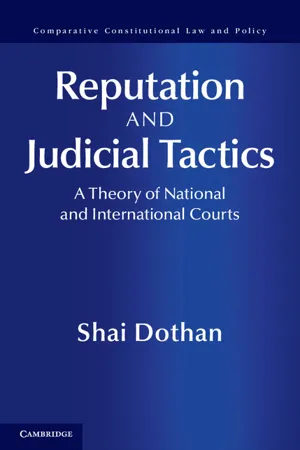
This book argues that national and international courts seek to enhance their reputations through the strategic exercise of judicial power. Courts often cannot enforce their judgments and must rely on reputational sanctions to ensure compliance. One way to do this is for courts to improve their reputation for generating compliance with their judgments. When the court's reputation is increased, parties will be expected to comply with its judgments and the reputational sanction on a party that fails to comply will be higher. This strategy allows national and international courts, which cannot enforce their judgments against states and executives, to improve the likelihood that their judgments will be complied with over time. This book describes the judicial tactics that courts use to shape their judgments in ways that maximize their reputational gains.
Information
Table of contents
- Cover
- Half-title
- Series information
- Title page
- Copyright information
- Dedication
- Table of contents
- Acknowledgments
- 1 Introduction
- 2 A theory of the reputation of courts
- 3 Constraints on courts
- 4 Tactics to increase courts' reputation
- 5 National court case study: Israeli Supreme Court
- 6 International court case study: European Court of Human Rights
- 7 When compliance is irrelevant
- 8 Conclusions
- Bibliography
- Index
Trusted by 375,005 students
Access to over 1.5 million titles for a fair monthly price.
Study more efficiently using our study tools.
Frequently asked questions
Yes, you can cancel anytime from the Subscription tab in your account settings on the Perlego website. Your subscription will stay active until the end of your current billing period. Learn how to cancel your subscription
No, books cannot be downloaded as external files, such as PDFs, for use outside of Perlego. However, you can download books within the Perlego app for offline reading on mobile or tablet. Learn how to download books offline
We are an online textbook subscription service, where you can get access to an entire online library for less than the price of a single book per month. With over 1.5 million books across 990+ topics, we’ve got you covered! Learn about our mission
Look out for the read-aloud symbol on your next book to see if you can listen to it. The read-aloud tool reads text aloud for you, highlighting the text as it is being read. You can pause it, speed it up and slow it down. Learn more about Read Aloud
Yes! You can use the Perlego app on both iOS and Android devices to read anytime, anywhere — even offline. Perfect for commutes or when you’re on the go.
Please note we cannot support devices running on iOS 13 and Android 7 or earlier. Learn more about using the app
Please note we cannot support devices running on iOS 13 and Android 7 or earlier. Learn more about using the app
Yes, you can access Reputation and Judicial Tactics by Shai Dothan in PDF and/or ePUB format, as well as other popular books in Law & Public Law. We have over 1.5 million books available in our catalogue for you to explore.