- 602 pages
- English
- PDF
- Available on iOS & Android
eBook - PDF
Complex Analysis with MATHEMATICA®
About this book
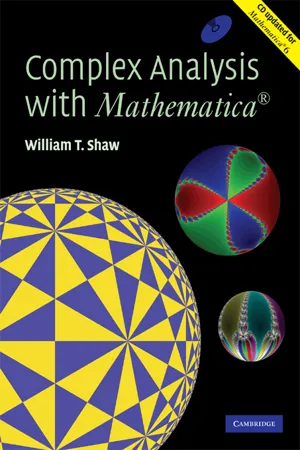
Complex Analysis with Mathematica offers a way of learning and teaching a subject that lies at the heart of many areas of pure and applied mathematics, physics, engineering and even art. This book offers teachers and students an opportunity to learn about complex numbers in a state-of-the-art computational environment. The innovative approach also offers insights into many areas too often neglected in a student treatment, including complex chaos and mathematical art. Thus readers can also use the book for self-study and for enrichment. The use of Mathematica enables the author to cover several topics that are often absent from a traditional treatment. Students are also led, optionally, into cubic or quartic equations, investigations of symmetric chaos and advanced conformal mapping. A CD is included which contains a live version of the book: in particular all the Mathematica code enables the user to run computer experiments.
Information
Table of contents
- Cover
- Complex Analysis with Mathematica
- Title
- Copyright
- Dedication
- Contents
- Preface
- 1 Why you need complex numbers
- 2 Complex algebra and geometry
- 3 Cubics, quartics and visualization of complex roots
- 4 Newton–Raphson iteration and complex fractals
- 5 A complex view of the real logistic map
- 6 The Mandelbrot set
- 7 Symmetric chaos in the complex plane
- 8 Complex functions
- 9 Sequences, series and power series
- 10 Complex differentiation
- 11 Paths and complex integration
- 12 Cauchy's theorem
- 13 Cauchy's integral formula and its remarkable consequences
- 14 Laurent series, zeroes, singularities and residues
- 15 Residue calculus: integration, summation and the argument principle
- 16 Conformal mapping I: simple mappings and Möbius transforms
- 17 Fourier transforms
- 18 Laplace transforms
- 19 Elementary applications to two-dimensional physics
- 20 Numerical transform techniques
- 21 Conformal mapping II: the Schwarz–Christoffel mapping
- 22 Tiling the Euclidean and hyperbolic planes
- 23 Physics in three and four dimensions I
- 24 Physics in three and four dimensions II
- Bibliography
- Index
Trusted by 375,005 students
Access to over 1.5 million titles for a fair monthly price.
Study more efficiently using our study tools.
Frequently asked questions
Yes, you can cancel anytime from the Subscription tab in your account settings on the Perlego website. Your subscription will stay active until the end of your current billing period. Learn how to cancel your subscription
No, books cannot be downloaded as external files, such as PDFs, for use outside of Perlego. However, you can download books within the Perlego app for offline reading on mobile or tablet. Learn how to download books offline
Perlego offers two plans: Essential and Complete
- Essential is ideal for learners and professionals who enjoy exploring a wide range of subjects. Access the Essential Library with 800,000+ trusted titles and best-sellers across business, personal growth, and the humanities. Includes unlimited reading time and Standard Read Aloud voice.
- Complete: Perfect for advanced learners and researchers needing full, unrestricted access. Unlock 1.5M+ books across hundreds of subjects, including academic and specialized titles. The Complete Plan also includes advanced features like Premium Read Aloud and Research Assistant.
We are an online textbook subscription service, where you can get access to an entire online library for less than the price of a single book per month. With over 1.5 million books across 990+ topics, we’ve got you covered! Learn about our mission
Look out for the read-aloud symbol on your next book to see if you can listen to it. The read-aloud tool reads text aloud for you, highlighting the text as it is being read. You can pause it, speed it up and slow it down. Learn more about Read Aloud
Yes! You can use the Perlego app on both iOS and Android devices to read anytime, anywhere — even offline. Perfect for commutes or when you’re on the go.
Please note we cannot support devices running on iOS 13 and Android 7 or earlier. Learn more about using the app
Please note we cannot support devices running on iOS 13 and Android 7 or earlier. Learn more about using the app
Yes, you can access Complex Analysis with MATHEMATICA® by William T. Shaw in PDF and/or ePUB format, as well as other popular books in Mathematics & Mathematical Analysis. We have over 1.5 million books available in our catalogue for you to explore.