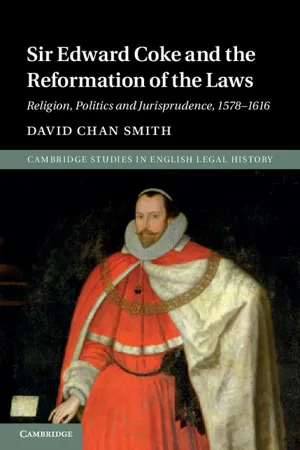
eBook - PDF
Sir Edward Coke and the Reformation of the Laws
Religion, Politics and Jurisprudence, 1578–1616
- 312 pages
- English
- PDF
- Available on iOS & Android
eBook - PDF
Sir Edward Coke and the Reformation of the Laws
Religion, Politics and Jurisprudence, 1578–1616
About this book
Throughout his early career, Sir Edward Coke joined many of his contemporaries in his concern about the uncertainty of the common law. Coke attributed this uncertainty to the ignorance and entrepreneurship of practitioners, litigants, and other users of legal power whose actions eroded confidence in the law. Working to limit their behaviours, Coke also simultaneously sought to strengthen royal authority and the Reformation settlement. Yet the tensions in his thought led him into conflict with James I, who had accepted many of the criticisms of the common law. Sir Edward Coke and the Reformation of the Laws reframes the origins of Coke's legal thought within the context of law reform and provides a new interpretation of his early career, the development of his legal thought, and the path from royalism to opposition in the turbulent decades leading up to the English civil wars.
Information
Table of contents
- Cover
- Half-title
- Series information
- Title page
- Copyright information
- Table of contents
- Acknowledgements
- List of abbreviations
- Introduction
- 1 Uncertainty and the reformation of the laws
- 2 ‘The most dangerous oppressor’
- 3 Confidence and corruption
- 4 Identity and the narratives of the past
- 5 Reason and reform
- 6 Pragmatism and the High Commission
- 7 Chancery, reform and the limits of cooperation
- 8 Delegation and moral kingship
- Conclusion
- Appendix: Serjeants created between 1577 and 1616 with practices in The Chancery from 1592 to 1615
- Index
Trusted by 375,005 students
Access to over 1.5 million titles for a fair monthly price.
Study more efficiently using our study tools.
Frequently asked questions
Yes, you can cancel anytime from the Subscription tab in your account settings on the Perlego website. Your subscription will stay active until the end of your current billing period. Learn how to cancel your subscription
No, books cannot be downloaded as external files, such as PDFs, for use outside of Perlego. However, you can download books within the Perlego app for offline reading on mobile or tablet. Learn how to download books offline
Perlego offers two plans: Essential and Complete
- Essential is ideal for learners and professionals who enjoy exploring a wide range of subjects. Access the Essential Library with 800,000+ trusted titles and best-sellers across business, personal growth, and the humanities. Includes unlimited reading time and Standard Read Aloud voice.
- Complete: Perfect for advanced learners and researchers needing full, unrestricted access. Unlock 1.5M+ books across hundreds of subjects, including academic and specialized titles. The Complete Plan also includes advanced features like Premium Read Aloud and Research Assistant.
We are an online textbook subscription service, where you can get access to an entire online library for less than the price of a single book per month. With over 1.5 million books across 990+ topics, we’ve got you covered! Learn about our mission
Look out for the read-aloud symbol on your next book to see if you can listen to it. The read-aloud tool reads text aloud for you, highlighting the text as it is being read. You can pause it, speed it up and slow it down. Learn more about Read Aloud
Yes! You can use the Perlego app on both iOS and Android devices to read anytime, anywhere — even offline. Perfect for commutes or when you’re on the go.
Please note we cannot support devices running on iOS 13 and Android 7 or earlier. Learn more about using the app
Please note we cannot support devices running on iOS 13 and Android 7 or earlier. Learn more about using the app
Yes, you can access Sir Edward Coke and the Reformation of the Laws by David Chan Smith in PDF and/or ePUB format, as well as other popular books in History & British History. We have over 1.5 million books available in our catalogue for you to explore.