- 960 pages
- English
- PDF
- Available on iOS & Android
eBook - PDF
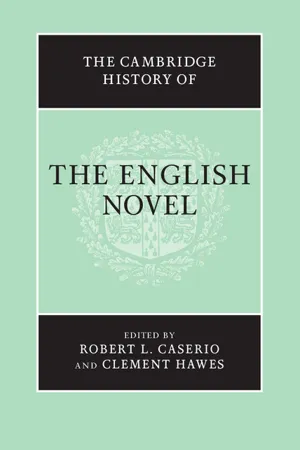
The Cambridge History of the English Novel
About this book
The Cambridge History of the English Novel chronicles an ever-changing and developing body of fiction across three centuries. An interwoven narrative of the novel's progress unfolds in more than fifty chapters, charting continuities and innovations of structure, tracing lines of influence in terms of themes and techniques, and showing how greater and lesser authors shape the genre. Pushing beyond the usual period-centered boundaries, the History's emphasis on form reveals the range and depth the novel has achieved in English. This book will be indispensable for research libraries and scholars, but is accessibly written for students. Authoritative, bold and clear, the History raises multiple useful questions for future visions of the invention and re-invention of the novel.
Information
Topic
LiteraturaSubtopic
Crítica literaria inglesaTable of contents
- Cover
- Half Title
- Title
- Copyright
- Contents
- Illustrations
- Contributors
- Acknowledgments
- Introduction
- 1 The novel before “the novel”
- 2 Biographical form in the novel
- 3 Legal discourse and novelistic form
- 4 Novelistic history
- 5 Interiorities
- 6 Samuel Richardson
- 7 Domesticities and novel narratives
- 8 Obscenity and the erotics of fiction
- 9 Cognitive alternatives to interiority
- 10 The novel, the British nation, and Britain’s four kingdoms
- 11 Money’s productivity in narrative fiction
- 12 “The southern unknown countries”: imagining the Pacific in the eighteenth-century novel
- 13 Editorial fictions: paratexts, fragments, and the novel
- 14 Extraordinary narrators: metafiction and it-narratives
- 15 Romance redivivus
- 16 Gothic success and gothic failure: formal innovation in a much-maligned genre
- 17 Sir Walter Scott: historiography contested by fiction
- 18 How and where we live now: Edgeworth, Austen, Dickens, and Trollope
- 19 From Wollstonecraft to Gissing: the revolutionary emergence of women, children, and labor in novelistic narrative
- 20 Spaces and places (I): the four nations
- 21 Dickens, Charlotte Brontë, Gaskell: politics and its limits
- 22 Populations: pictures of prose in Hardy, Austen, Eliot, and Thackeray
- 23 The novel amid new sciences
- 24 George Eliot’s past and present: emblematic histories
- 25 The Bildungsroman
- 26 The novel and social cognition: internalist and externalist perspectives
- 27 Clamors of eros
- 28 The novel as immoral, anti-social force
- 29 Sensations: gothic, horror, crime fiction, detective fiction
- 30 Realism and romance
- 31 Spaces and places (II): around the globe
- 32 Imperial romance
- 33 The art novel: Impressionists and aesthetes
- 34 The impact of lyric, drama, and verse narrative on novel form
- 35 Henry James and Joseph Conrad: the pursuit of autonomy
- 36 Joyce: the modernist novel’s revolution in matter and manner
- 37 Richardson, Woolf, Lawrence: the modernist novel’s experiments with narrative (I)
- 38 Wells, Forster, Firbank, Lewis, Huxley, Compton-Burnett, Green: the modernist novel’s experiments with narrative (II)
- 39 Beyond autonomy: political dimensions of modernist novels
- 40 Fiction by women: continuities and changes, 1930–1990
- 41 The novel amid other discourses
- 42 The novel and thirty years of war
- 43 Thrillers
- 44 Novelistic complications of spaces and places: the four nations and regionalism
- 45 The series novel: a dominant form
- 46 The novel’s West Indian revolution
- 47 Postwar renewals of experiment 1945–1979
- 48 The novel amid new technology and media
- 49 Novels of same-sex desire
- 50 From Wells to John Berger: the social democratic era of the novel
- 51 The postcolonial novel: history and memory
- 52 History and heritage: the English novel’s persistent historiographical turn
- 53 Twentieth-century satire: the poetics and politics of negativity
- 54 Unending romance: science fiction and fantasy in the twentieth century
- Select bibliography
- Index
Trusted by 375,005 students
Access to over 1.5 million titles for a fair monthly price.
Study more efficiently using our study tools.
Frequently asked questions
Yes, you can cancel anytime from the Subscription tab in your account settings on the Perlego website. Your subscription will stay active until the end of your current billing period. Learn how to cancel your subscription
No, books cannot be downloaded as external files, such as PDFs, for use outside of Perlego. However, you can download books within the Perlego app for offline reading on mobile or tablet. Learn how to download books offline
Perlego offers two plans: Essential and Complete
- Essential is ideal for learners and professionals who enjoy exploring a wide range of subjects. Access the Essential Library with 800,000+ trusted titles and best-sellers across business, personal growth, and the humanities. Includes unlimited reading time and Standard Read Aloud voice.
- Complete: Perfect for advanced learners and researchers needing full, unrestricted access. Unlock 1.5M+ books across hundreds of subjects, including academic and specialized titles. The Complete Plan also includes advanced features like Premium Read Aloud and Research Assistant.
We are an online textbook subscription service, where you can get access to an entire online library for less than the price of a single book per month. With over 1.5 million books across 990+ topics, we’ve got you covered! Learn about our mission
Look out for the read-aloud symbol on your next book to see if you can listen to it. The read-aloud tool reads text aloud for you, highlighting the text as it is being read. You can pause it, speed it up and slow it down. Learn more about Read Aloud
Yes! You can use the Perlego app on both iOS and Android devices to read anytime, anywhere — even offline. Perfect for commutes or when you’re on the go.
Please note we cannot support devices running on iOS 13 and Android 7 or earlier. Learn more about using the app
Please note we cannot support devices running on iOS 13 and Android 7 or earlier. Learn more about using the app
Yes, you can access The Cambridge History of the English Novel by Robert L. Caserio,Clement Hawes in PDF and/or ePUB format, as well as other popular books in Literatura & Crítica literaria inglesa. We have over 1.5 million books available in our catalogue for you to explore.