eBook - PDF
Poverty Knowledge in South Africa
A Social History of Human Science, 1855–2005
- 346 pages
- English
- PDF
- Available on iOS & Android
eBook - PDF
About this book
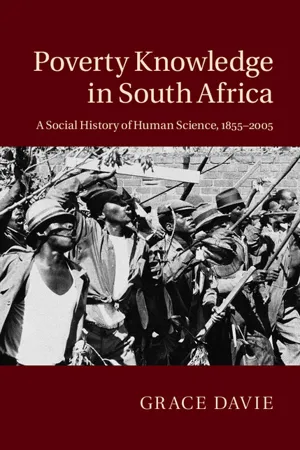
Poverty is South Africa's greatest challenge. But what is 'poverty'? How can it be measured? And how can it be reduced if not eliminated? In South Africa, human science knowledge about the cost of living grew out of colonialism, industrialization, apartheid and civil resistance campaigns, which makes this knowledge far from neutral or apolitical. South Africans have used the Poverty Datum Line (PDL), Gini coefficients and other poverty thresholds to petition the state, to chip away at the pillars of white supremacy, and, more recently, to criticize the postapartheid government's failures to deliver on some of its promises. Rather than promoting one particular policy solution, this book argues that poverty knowledge teaches us about the dynamics of historical change, the power of racism in white settler societies, and the role of grassroots protest movements in shaping state policies and scientific categories. Readers will gain new perspectives on today's debates about social welfare, redistribution and human rights, and will ultimately find reasons to rethink conventional approaches to advocacy.
Information
Table of contents
- Cover
- Half-title Page
- Title page
- Copyright Page
- Dedication
- Contents
- Figures
- Acknowledgments
- Introduction: the poverty question in South Africa
- Part I Lay knowledge meets human science, 1855–1940: The co-production of the “poor white problem”
- Part II The limits of invention: Social reform and quantitative objectivity, 1940–1970
- Part III The people’s facts: Epistemic mobility and the negotiated settlement, 1970–2005
- Select Bibliography
- Index
Trusted by 375,005 students
Access to over 1.5 million titles for a fair monthly price.
Study more efficiently using our study tools.
Frequently asked questions
Yes, you can cancel anytime from the Subscription tab in your account settings on the Perlego website. Your subscription will stay active until the end of your current billing period. Learn how to cancel your subscription
No, books cannot be downloaded as external files, such as PDFs, for use outside of Perlego. However, you can download books within the Perlego app for offline reading on mobile or tablet. Learn how to download books offline
We are an online textbook subscription service, where you can get access to an entire online library for less than the price of a single book per month. With over 1.5 million books across 990+ topics, we’ve got you covered! Learn about our mission
Look out for the read-aloud symbol on your next book to see if you can listen to it. The read-aloud tool reads text aloud for you, highlighting the text as it is being read. You can pause it, speed it up and slow it down. Learn more about Read Aloud
Yes! You can use the Perlego app on both iOS and Android devices to read anytime, anywhere — even offline. Perfect for commutes or when you’re on the go.
Please note we cannot support devices running on iOS 13 and Android 7 or earlier. Learn more about using the app
Please note we cannot support devices running on iOS 13 and Android 7 or earlier. Learn more about using the app
Yes, you can access Poverty Knowledge in South Africa by Grace Davie in PDF and/or ePUB format, as well as other popular books in History & African History. We have over 1.5 million books available in our catalogue for you to explore.