- 516 pages
- English
- PDF
- Available on iOS & Android
eBook - PDF
The New Entrants Problem in International Fisheries Law
About this book
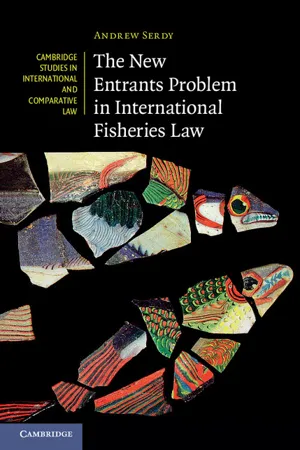
Are international fisheries heading away from open access to a global commons towards a regime of property rights? The distributional implications of denying access to newcomers and re-entrants that used the resource in the past are fraught. Should the winners in this process compensate the losers and, if so, how? Regional fisheries management organisations, in whose gift participatory rights increasingly lie, are perceptibly shifting their attention to this approach, which has hitherto been little analysed; this book provides a review of the practice of these bodies and the States that are their members. The recently favoured response of governments, combating 'IUU' - illegal, unregulated and unreported - fishing, is shown to rest on a flawed concept, and the solution might lie less in law than in legal policy: compulsory dispute settlement to moderate their claims and an expansion of the possibilities of trading of quotas to make solving the global overcapacity issue easier.
Information
Table of contents
- Cover
- Half title
- Seriespage
- Title
- Copyright
- Contents
- Acknowledgements
- Table of treaties
- Table of legislation
- Table of cases
- Abbreviations
- 1 The bioeconomics of high seas fishing: new entrants and the tragedy of the commons
- 2 New entrants, old problem: allocation principles in the UN Fish Stocks Agreement and other treaties
- 3 A wrong turning in international fisheries law: the flawed concept(s) of illegal, unreported and unregulated fishing
- 4 Case study: new entrants and the Commission for the Conservation of Southern Bluefin Tuna
- 5 Quota trading in international fisheries commissions: an idea whose time has come?
- 6 Conclusions: a role for State responsibility?
- Select bibliography
- Index
Trusted by 375,005 students
Access to over 1.5 million titles for a fair monthly price.
Study more efficiently using our study tools.
Frequently asked questions
Yes, you can cancel anytime from the Subscription tab in your account settings on the Perlego website. Your subscription will stay active until the end of your current billing period. Learn how to cancel your subscription
No, books cannot be downloaded as external files, such as PDFs, for use outside of Perlego. However, you can download books within the Perlego app for offline reading on mobile or tablet. Learn how to download books offline
Perlego offers two plans: Essential and Complete
- Essential is ideal for learners and professionals who enjoy exploring a wide range of subjects. Access the Essential Library with 800,000+ trusted titles and best-sellers across business, personal growth, and the humanities. Includes unlimited reading time and Standard Read Aloud voice.
- Complete: Perfect for advanced learners and researchers needing full, unrestricted access. Unlock 1.5M+ books across hundreds of subjects, including academic and specialized titles. The Complete Plan also includes advanced features like Premium Read Aloud and Research Assistant.
We are an online textbook subscription service, where you can get access to an entire online library for less than the price of a single book per month. With over 1.5 million books across 990+ topics, we’ve got you covered! Learn about our mission
Look out for the read-aloud symbol on your next book to see if you can listen to it. The read-aloud tool reads text aloud for you, highlighting the text as it is being read. You can pause it, speed it up and slow it down. Learn more about Read Aloud
Yes! You can use the Perlego app on both iOS and Android devices to read anytime, anywhere — even offline. Perfect for commutes or when you’re on the go.
Please note we cannot support devices running on iOS 13 and Android 7 or earlier. Learn more about using the app
Please note we cannot support devices running on iOS 13 and Android 7 or earlier. Learn more about using the app
Yes, you can access The New Entrants Problem in International Fisheries Law by Andrew Serdy in PDF and/or ePUB format, as well as other popular books in Law & International Law. We have over 1.5 million books available in our catalogue for you to explore.