- 260 pages
- English
- PDF
- Available on iOS & Android
eBook - PDF
About this book
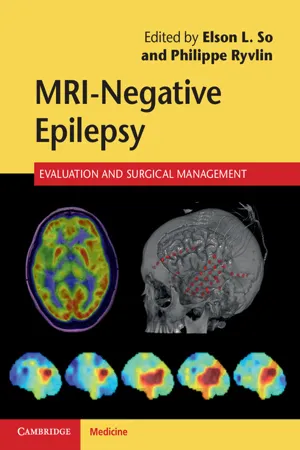
Drug-resistant epilepsy with negative MRI is frequently seen in patients considered for epilepsy surgery; however, clinical evaluation and surgical treatment is very complex and challenging. Advanced imaging techniques are needed to detect the location of the epileptogenic zone. In most cases, intracranial EEG recording is required to delineate the region of seizure onset - this carries some risks of major complications. Moreover, the borders between the recorded seizure onset and the location of important brain functions are often indistinct in MRI-negative epilepsy. Overall, the outcome of MRI-negative surgery is less favorable than that of MRI-positive surgery, but it can significantly improve with optimal management. Each chapter critically appraises the role and value of specific diagnostic and treatment techniques to address the challenges of MRI-negative epilepsy surgery. Authors critique evidence and share their expertise on the diagnostic options and surgical approaches that make epilepsy surgery possible and worthwhile in patients with this condition.
Information
Table of contents
- Cover
- Half-title
- Title page
- Copyright information
- Dedication
- Table of contents
- List of contributors
- Preface
- Chapter 1 Scope and implications of MRI-negative refractory focal epilepsy
- Chapter 2 Seizure semiology and scalp EEG in MRI-negative refractory focal epilepsy
- Chapter 3 Clinical and advanced techniques for optimizing MRI in refractory focal epilepsy
- Chapter 4 PET in MRI-negative refractory focal epilepsy
- Chapter 5 Advanced SPECT image processing in MRI-negative refractory focal epilepsy
- Chapter 6 MEG and magnetic source imaging in MRI-negative refractory focal epilepsy
- Chapter 7 Electric source imaging in MRI-negative refractory focal epilepsy
- Chapter 8 Functional MRI in MRI-negative refractory focal epilepsy
- Chapter 9 Multimodality image coregistration for MRI-negative epilepsy surgery
- Chapter 10 Subdural electrode implantation and recording in MRI-negative epilepsy surgery
- Chapter 11 Depth electrode and stereoelectroencephalography in MRI-negative epilepsy
- Chapter 12 Ultraslow and high-frequency recordings in MRI-negative refractory focal epilepsy
- Chapter 13 Cortical mapping in MRI-negative epilepsy surgery
- Chapter 14 Localization and surgery for MRI-negative temporal lobe and temporal-plus epilepsies
- Chapter 15 Localization and surgery in MRI-negative frontal lobe epilepsies
- Chapter 16 Localization and surgery in MRI-negative posterior cortex epilepsies
- Chapter 17 MRI-negative refractory focal epilepsy in childhood
- Chapter 18 Surgical approaches and techniques in MRI-negative focal epilepsy
- Chapter 19 Histopathology findings in MRI-negative focal epilepsy
- Chapter 20 Neuropsychological issues in MRI-negative focal epilepsy surgery: evaluation and outcomes
- Chapter 21 Conclusion
- Index
Trusted by 375,005 students
Access to over 1.5 million titles for a fair monthly price.
Study more efficiently using our study tools.
Frequently asked questions
Yes, you can cancel anytime from the Subscription tab in your account settings on the Perlego website. Your subscription will stay active until the end of your current billing period. Learn how to cancel your subscription
No, books cannot be downloaded as external files, such as PDFs, for use outside of Perlego. However, you can download books within the Perlego app for offline reading on mobile or tablet. Learn how to download books offline
Perlego offers two plans: Essential and Complete
- Essential is ideal for learners and professionals who enjoy exploring a wide range of subjects. Access the Essential Library with 800,000+ trusted titles and best-sellers across business, personal growth, and the humanities. Includes unlimited reading time and Standard Read Aloud voice.
- Complete: Perfect for advanced learners and researchers needing full, unrestricted access. Unlock 1.5M+ books across hundreds of subjects, including academic and specialized titles. The Complete Plan also includes advanced features like Premium Read Aloud and Research Assistant.
We are an online textbook subscription service, where you can get access to an entire online library for less than the price of a single book per month. With over 1.5 million books across 990+ topics, we’ve got you covered! Learn about our mission
Look out for the read-aloud symbol on your next book to see if you can listen to it. The read-aloud tool reads text aloud for you, highlighting the text as it is being read. You can pause it, speed it up and slow it down. Learn more about Read Aloud
Yes! You can use the Perlego app on both iOS and Android devices to read anytime, anywhere — even offline. Perfect for commutes or when you’re on the go.
Please note we cannot support devices running on iOS 13 and Android 7 or earlier. Learn more about using the app
Please note we cannot support devices running on iOS 13 and Android 7 or earlier. Learn more about using the app
Yes, you can access MRI-Negative Epilepsy by Elson L. So,Philippe Ryvlin in PDF and/or ePUB format, as well as other popular books in Medicine & Neurology. We have over 1.5 million books available in our catalogue for you to explore.