- 322 pages
- English
- PDF
- Available on iOS & Android
eBook - PDF
About this book
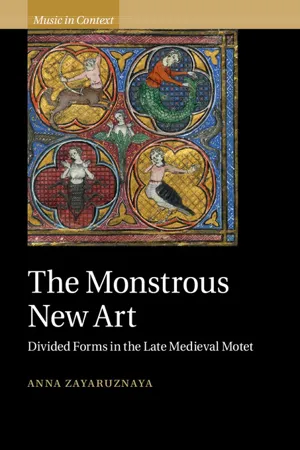
Late medieval motet texts are brimming with chimeras, centaurs and other strange creatures. In The Monstrous New Art, Anna Zayaruznaya explores the musical ramifications of this menagerie in the works of composers Guillaume de Machaut, Philippe de Vitry, and their contemporaries. Aligning the larger forms of motets with the broad sacred and secular themes of their texts, Zayaruznaya shows how monstrous or hybrid exempla are musically sculpted by rhythmic and textural means. These divisive musical procedures point to the contradictory aspects not only of explicitly monstrous bodies, but of such apparently unified entities as the body politic, the courtly lady, and the Holy Trinity. Zayaruznaya casts a new light on medieval modes of musical representation, with profound implications for broader disciplinary narratives about the history of text-music relations, the emergence of musical unity, and the ontology of the musical work.
Information
Subtopic
MusicTable of contents
- Cover
- Half-title page
- Series page
- Title page
- Copyright page
- Dedication
- Contents
- Illustrations
- Music examples
- Tables
- Supplementary online content
- Acknowledgements
- Introduction
- 1 Songs alive
- 2 How (not) to write a motet: The exemplary In virtute/Decens
- 3 Motet visions of an apocalyptic statue
- 4 Interlude: Nebuchadnezzar’s dream
- 5 Ars nova and division
- Appendix 1 Philippe de Vitry, In virtute/Decens: Texts, translations, and music
- Appendix 2 Philippe de Vitry, Cum statua/Hugo: Texts, translations, and music
- Appendix 3 Philippe de Vitry, Phi millies/O creator: Texts, translations, and music
- Appendix 4 Anonymous, Post Missarum/Post misse: Texts and translations
- Appendix 5 Anonymous, Fortune/Ma dolour: Texts and translations
- Appendix 6 Anonymous, Amer/Durement: Texts and translations
- Appendix 7 Philippe de Vitry, Firmissime/Adesto: Texts and translations
- Appendix 8 Anonymous, Beatius/Cum humanum: Texts and translations
- Glossary
- Bibliography
- Index of Compositions
- General Index
Trusted by 375,005 students
Access to over 1.5 million titles for a fair monthly price.
Study more efficiently using our study tools.
Frequently asked questions
Yes, you can cancel anytime from the Subscription tab in your account settings on the Perlego website. Your subscription will stay active until the end of your current billing period. Learn how to cancel your subscription
No, books cannot be downloaded as external files, such as PDFs, for use outside of Perlego. However, you can download books within the Perlego app for offline reading on mobile or tablet. Learn how to download books offline
Perlego offers two plans: Essential and Complete
- Essential is ideal for learners and professionals who enjoy exploring a wide range of subjects. Access the Essential Library with 800,000+ trusted titles and best-sellers across business, personal growth, and the humanities. Includes unlimited reading time and Standard Read Aloud voice.
- Complete: Perfect for advanced learners and researchers needing full, unrestricted access. Unlock 1.5M+ books across hundreds of subjects, including academic and specialized titles. The Complete Plan also includes advanced features like Premium Read Aloud and Research Assistant.
We are an online textbook subscription service, where you can get access to an entire online library for less than the price of a single book per month. With over 1.5 million books across 990+ topics, we’ve got you covered! Learn about our mission
Look out for the read-aloud symbol on your next book to see if you can listen to it. The read-aloud tool reads text aloud for you, highlighting the text as it is being read. You can pause it, speed it up and slow it down. Learn more about Read Aloud
Yes! You can use the Perlego app on both iOS and Android devices to read anytime, anywhere — even offline. Perfect for commutes or when you’re on the go.
Please note we cannot support devices running on iOS 13 and Android 7 or earlier. Learn more about using the app
Please note we cannot support devices running on iOS 13 and Android 7 or earlier. Learn more about using the app
Yes, you can access The Monstrous New Art by Anna Zayaruznaya in PDF and/or ePUB format, as well as other popular books in Media & Performing Arts & Music. We have over 1.5 million books available in our catalogue for you to explore.