eBook - PDF
In Search of the New Woman
Middle-Class Women and Work in Britain 1870–1914
- 202 pages
- English
- PDF
- Available on iOS & Android
eBook - PDF
About this book
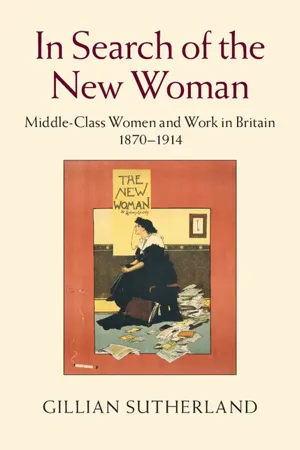
The 'New Women' of late nineteenth-century Britain were seen as defying society's conventions. Studying this phenomenon from its origins in the 1870s to the outbreak of the Great War, Gillian Sutherland examines whether women really had the economic freedom to challenge norms relating to work, political action, love and marriage, and surveys literary and pictorial representations of the New Woman. She considers the proportion of middle-class women who were in employment and the work they did, and compares the different experiences of women who went to Oxbridge and those who went to other universities. Juxtaposing them against the period's rapidly expanding but seldom studied groups of women white-collar workers, the book pays particular attention to clerks and teachers, and their political engagement. It also explores the dividing lines between ladies and women, the significance of respectability and the interactions of class, status and gender lying behind such distinctions.
Table of contents
- Cover
- Half-title page
- Ttitle page
- Copyright page
- Dedication
- Contents
- Figures and tables
- Acknowledgements
- 1 ‘a sort of Bogey whom no-one has ever seen’? The nature of the search
- 2 ‘all that she sees before her hellip is teaching’: formal schooling and its opportunities
- 3 ‘the exercise of what may be termed her maternal faculties’: public service and ‘caring’ occupations
- 4 ‘impossible for a lady to remain a lady’: art, literature and the theatre
- 5 ‘The real social divide existed between those who hellip dirtied hands and face and those who did not’: women white-collar workers (I)
- 6 ‘a beggarly makeshift, but for me it was wealth beyond price’: women white-collar workers (II)
- 7 Ladies and women
- 8 Some conclusions: degrees of freedom
- Sources and select bibliography
- Index
Trusted by 375,005 students
Access to over 1.5 million titles for a fair monthly price.
Study more efficiently using our study tools.
Information
Publisher
Cambridge University PressYear
2015Topic
HistoriaPrint ISBN
9781107092792
Subtopic
Historia británicaeBook ISBN
9781316237281
Frequently asked questions
Yes, you can cancel anytime from the Subscription tab in your account settings on the Perlego website. Your subscription will stay active until the end of your current billing period. Learn how to cancel your subscription
No, books cannot be downloaded as external files, such as PDFs, for use outside of Perlego. However, you can download books within the Perlego app for offline reading on mobile or tablet. Learn how to download books offline
Perlego offers two plans: Essential and Complete
- Essential is ideal for learners and professionals who enjoy exploring a wide range of subjects. Access the Essential Library with 800,000+ trusted titles and best-sellers across business, personal growth, and the humanities. Includes unlimited reading time and Standard Read Aloud voice.
- Complete: Perfect for advanced learners and researchers needing full, unrestricted access. Unlock 1.5M+ books across hundreds of subjects, including academic and specialized titles. The Complete Plan also includes advanced features like Premium Read Aloud and Research Assistant.
We are an online textbook subscription service, where you can get access to an entire online library for less than the price of a single book per month. With over 1.5 million books across 990+ topics, we’ve got you covered! Learn about our mission
Look out for the read-aloud symbol on your next book to see if you can listen to it. The read-aloud tool reads text aloud for you, highlighting the text as it is being read. You can pause it, speed it up and slow it down. Learn more about Read Aloud
Yes! You can use the Perlego app on both iOS and Android devices to read anytime, anywhere — even offline. Perfect for commutes or when you’re on the go.
Please note we cannot support devices running on iOS 13 and Android 7 or earlier. Learn more about using the app
Please note we cannot support devices running on iOS 13 and Android 7 or earlier. Learn more about using the app
Yes, you can access In Search of the New Woman by Gillian Sutherland in PDF and/or ePUB format, as well as other popular books in Historia & Historia británica. We have over 1.5 million books available in our catalogue for you to explore.