- 414 pages
- English
- PDF
- Available on iOS & Android
eBook - PDF
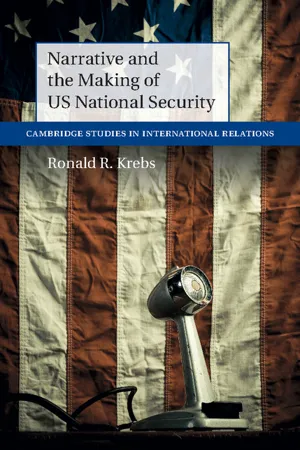
Narrative and the Making of US National Security
About this book
Dominant narratives - from the Cold War consensus to the War on Terror - have often served as the foundation for debates over national security. Weaving current challenges, past failures and triumphs, and potential futures into a coherent tale, with well-defined characters and plot lines, these narratives impart meaning to global events, define the boundaries of legitimate politics, and thereby shape national security policy. However, we know little about why or how such narratives rise and fall. Drawing on insights from diverse fields, Narrative and the Making of US National Security offers novel arguments about where these dominant narratives come from, how they become dominant, and when they collapse. It evaluates these arguments carefully against evidence drawn from US debates over national security from the 1930s to the 2000s, and shows how these narrative dynamics have shaped the policies pursued by the United States.
Information
Table of contents
- Cover
- Half-title page
- Series page
- Title page
- Copyright page
- Dedication
- Contents
- Figures
- Tables
- Acknowledgments
- 1 Narrating national security
- Part I Crisis, authority, and rhetorical mode: the fate of narrative projects, from the battle against isolationism to the War on Terror
- Part II Narrative at war: politics and rhetorical strategy in the military crucible, from Korea to Iraq
- Appendix A Content analysis: method
- Appendix B Content analysis: FDR’s major foreign affairs addresses, 1935 to 1945
- Appendix C Presidential speech and storytelling: descriptive data
- Appendix D Coding the Cold War consensus
- References
- Index
Trusted by 375,005 students
Access to over 1.5 million titles for a fair monthly price.
Study more efficiently using our study tools.
Frequently asked questions
Yes, you can cancel anytime from the Subscription tab in your account settings on the Perlego website. Your subscription will stay active until the end of your current billing period. Learn how to cancel your subscription
No, books cannot be downloaded as external files, such as PDFs, for use outside of Perlego. However, you can download books within the Perlego app for offline reading on mobile or tablet. Learn how to download books offline
Perlego offers two plans: Essential and Complete
- Essential is ideal for learners and professionals who enjoy exploring a wide range of subjects. Access the Essential Library with 800,000+ trusted titles and best-sellers across business, personal growth, and the humanities. Includes unlimited reading time and Standard Read Aloud voice.
- Complete: Perfect for advanced learners and researchers needing full, unrestricted access. Unlock 1.5M+ books across hundreds of subjects, including academic and specialized titles. The Complete Plan also includes advanced features like Premium Read Aloud and Research Assistant.
We are an online textbook subscription service, where you can get access to an entire online library for less than the price of a single book per month. With over 1.5 million books across 990+ topics, we’ve got you covered! Learn about our mission
Look out for the read-aloud symbol on your next book to see if you can listen to it. The read-aloud tool reads text aloud for you, highlighting the text as it is being read. You can pause it, speed it up and slow it down. Learn more about Read Aloud
Yes! You can use the Perlego app on both iOS and Android devices to read anytime, anywhere — even offline. Perfect for commutes or when you’re on the go.
Please note we cannot support devices running on iOS 13 and Android 7 or earlier. Learn more about using the app
Please note we cannot support devices running on iOS 13 and Android 7 or earlier. Learn more about using the app
Yes, you can access Narrative and the Making of US National Security by Ronald R. Krebs in PDF and/or ePUB format, as well as other popular books in Politics & International Relations & International Relations. We have over 1.5 million books available in our catalogue for you to explore.