- 424 pages
- English
- PDF
- Available on iOS & Android
eBook - PDF
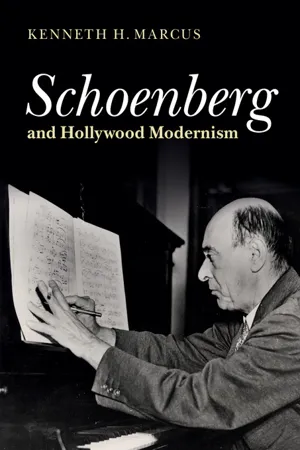
Schoenberg and Hollywood Modernism
About this book
Schoenberg is often viewed as an isolated composer who was ill-at-ease in exile. In this book Kenneth H. Marcus shows that in fact Schoenberg's connections to Hollywood ran deep, and most of the composer's exile compositions had some connection to the cultural and intellectual environment in which he found himself. He was friends with numerous successful film industry figures, including George Gershwin, Oscar Levant, David Raksin and Alfred Newman, and each contributed to the composer's life and work in different ways: helping him to obtain students, making recordings of his music, and arranging commissions. While teaching at both the University of Southern California and the University of California, Los Angeles, Schoenberg was able to bridge two utterly different worlds: the film industry and the academy. Marcus shows that alongside Schoenberg's vital impact upon Southern California Modernism through his pedagogy, compositions and texts, he also taught students who became central to American musical modernism, including John Cage and Lou Harrison.
Information
Subtopic
MusicTable of contents
- Cover
- Half title
- Title
- Copyright
- Dedication
- Contents
- List of figures
- List of maps
- List of music examples
- Acknowledgments
- List of abbreviations
- Introduction
- Part I: Modernism in Southern California, 1913–1944
- Part II: The private and public spheres, 1936–1951
- Conclusion
- Appendices
- Notes
- Bibliography
- Index
Trusted by 375,005 students
Access to over 1.5 million titles for a fair monthly price.
Study more efficiently using our study tools.
Frequently asked questions
Yes, you can cancel anytime from the Subscription tab in your account settings on the Perlego website. Your subscription will stay active until the end of your current billing period. Learn how to cancel your subscription
No, books cannot be downloaded as external files, such as PDFs, for use outside of Perlego. However, you can download books within the Perlego app for offline reading on mobile or tablet. Learn how to download books offline
We are an online textbook subscription service, where you can get access to an entire online library for less than the price of a single book per month. With over 1.5 million books across 990+ topics, we’ve got you covered! Learn about our mission
Look out for the read-aloud symbol on your next book to see if you can listen to it. The read-aloud tool reads text aloud for you, highlighting the text as it is being read. You can pause it, speed it up and slow it down. Learn more about Read Aloud
Yes! You can use the Perlego app on both iOS and Android devices to read anytime, anywhere — even offline. Perfect for commutes or when you’re on the go.
Please note we cannot support devices running on iOS 13 and Android 7 or earlier. Learn more about using the app
Please note we cannot support devices running on iOS 13 and Android 7 or earlier. Learn more about using the app
Yes, you can access Schoenberg and Hollywood Modernism by Kenneth H. Marcus in PDF and/or ePUB format, as well as other popular books in Media & Performing Arts & Music. We have over 1.5 million books available in our catalogue for you to explore.