- 416 pages
- English
- PDF
- Available on iOS & Android
eBook - PDF
About this book
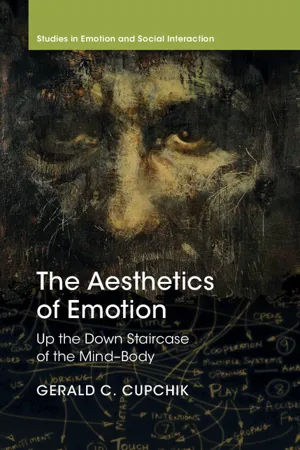
Gerald C. Cupchik builds a bridge between science and the humanities, arguing that interactions between mind and body in everyday life are analogous to relations between subject matter and style in art. According to emotional phase theory, emotional reactions emerge in a 'perfect storm' whereby meaningful situations evoke bodily memories that unconsciously shape and unify the experience. Similarly, in expressionist or impressionist painting, an evocative visual style can spontaneously colour the experience and interpretation of subject matter. Three basic situational themes encompass complementary pairs of primary emotions: attachment (happiness - sadness), assertion (fear - anger), and absorption (interest - disgust). Action episodes, in which a person adapts to challenges or seeks to realize goals, benefit from energizing bodily responses which focus attention on the situation while providing feedback, in the form of pleasure or pain, regarding success or failure. In high representational paintings, style is transparent, making it easier to fluently identify subject matter.
Information
Table of contents
- Cover
- Half-title
- Series information
- Title page
- Copyright information
- Dedication
- Table of contents
- List of figures
- Preface
- Acknowledgments
- Prologue
- Chapter 1 Experiences in life and in art
- Chapter 2 Thinking critically about emotion theories
- Chapter 3 The depth of affective processing
- Chapter 4 Emotional experiences as reactions
- Chapter 5 Antecedents of the motivational action models
- Chapter 6 Emotional Phase Theory
- Chapter 7 Neural underpinnings of emotional experiences and feeling-based actions
- Chapter 8 The aesthetic imagination
- Chapter 9 Affective processes and aesthetic reception
- Chapter 10 The ‘‘aesthetics of emotion’’ as analogy and metaphor
- Chapter 11 Creative practices of contemporary artists
- Chapter 12 The cave artist’s share
- Chapter 13 Studies in aesthetic reception
- Chapter 14 In search of a unified emotion theory
- References
- Index
- Series list
Trusted by 375,005 students
Access to over 1.5 million titles for a fair monthly price.
Study more efficiently using our study tools.
Frequently asked questions
Yes, you can cancel anytime from the Subscription tab in your account settings on the Perlego website. Your subscription will stay active until the end of your current billing period. Learn how to cancel your subscription
No, books cannot be downloaded as external files, such as PDFs, for use outside of Perlego. However, you can download books within the Perlego app for offline reading on mobile or tablet. Learn how to download books offline
Perlego offers two plans: Essential and Complete
- Essential is ideal for learners and professionals who enjoy exploring a wide range of subjects. Access the Essential Library with 800,000+ trusted titles and best-sellers across business, personal growth, and the humanities. Includes unlimited reading time and Standard Read Aloud voice.
- Complete: Perfect for advanced learners and researchers needing full, unrestricted access. Unlock 1.5M+ books across hundreds of subjects, including academic and specialized titles. The Complete Plan also includes advanced features like Premium Read Aloud and Research Assistant.
We are an online textbook subscription service, where you can get access to an entire online library for less than the price of a single book per month. With over 1.5 million books across 990+ topics, we’ve got you covered! Learn about our mission
Look out for the read-aloud symbol on your next book to see if you can listen to it. The read-aloud tool reads text aloud for you, highlighting the text as it is being read. You can pause it, speed it up and slow it down. Learn more about Read Aloud
Yes! You can use the Perlego app on both iOS and Android devices to read anytime, anywhere — even offline. Perfect for commutes or when you’re on the go.
Please note we cannot support devices running on iOS 13 and Android 7 or earlier. Learn more about using the app
Please note we cannot support devices running on iOS 13 and Android 7 or earlier. Learn more about using the app
Yes, you can access The Aesthetics of Emotion by Gerald C. Cupchik in PDF and/or ePUB format, as well as other popular books in Psychology & Social Psychology. We have over 1.5 million books available in our catalogue for you to explore.