- 368 pages
- English
- PDF
- Available on iOS & Android
eBook - PDF
Positive Approaches to Optimal Relationship Development
About this book
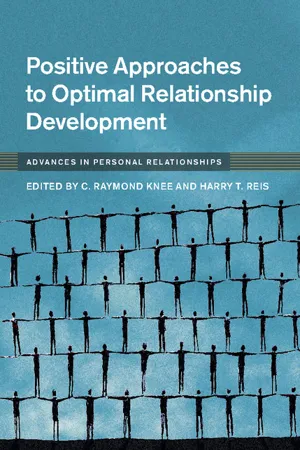
How can we get the most out of our close relationships? Research in the area of personal relationships continues to grow, but most prior work has emphasized how to overcome negative aspects. This volume demonstrates that a good relationship is more than simply the absence of a bad relationship, and that establishing and maintaining optimal relationships entails enacting a set of processes that are distinct from merely avoiding negative or harmful behaviors. Drawing on recent relationship science to explore issues such as intimacy, attachment, passion, sacrifice, and compassionate goals, the essays in this volume emphasize the positive features that allow relationships to flourish. In doing so, they integrate several theoretical perspectives, concepts, and mechanisms that produce optimal relationships. The volume also includes a section on intensive and abbreviated interventions that have been empirically validated to be effective in promoting the positive features of close relationships.
Information
Topic
PsicologiaSubtopic
Psicologia socialeTable of contents
- Cover
- Half-title page
- Series page
- Title page
- Copyright page
- Contents
- Figures and tables
- Contributors
- Preface
- Part I Major theoretical perspectives
- Part II Concepts and mechanisms
- Part III Effective interventions
- Index
Trusted by 375,005 students
Access to over 1.5 million titles for a fair monthly price.
Study more efficiently using our study tools.
Frequently asked questions
Yes, you can cancel anytime from the Subscription tab in your account settings on the Perlego website. Your subscription will stay active until the end of your current billing period. Learn how to cancel your subscription
No, books cannot be downloaded as external files, such as PDFs, for use outside of Perlego. However, you can download books within the Perlego app for offline reading on mobile or tablet. Learn how to download books offline
We are an online textbook subscription service, where you can get access to an entire online library for less than the price of a single book per month. With over 1.5 million books across 990+ topics, we’ve got you covered! Learn about our mission
Look out for the read-aloud symbol on your next book to see if you can listen to it. The read-aloud tool reads text aloud for you, highlighting the text as it is being read. You can pause it, speed it up and slow it down. Learn more about Read Aloud
Yes! You can use the Perlego app on both iOS and Android devices to read anytime, anywhere — even offline. Perfect for commutes or when you’re on the go.
Please note we cannot support devices running on iOS 13 and Android 7 or earlier. Learn more about using the app
Please note we cannot support devices running on iOS 13 and Android 7 or earlier. Learn more about using the app
Yes, you can access Positive Approaches to Optimal Relationship Development by C. Raymond Knee,Harry T. Reis in PDF and/or ePUB format, as well as other popular books in Psicologia & Psicologia sociale. We have over 1.5 million books available in our catalogue for you to explore.