eBook - PDF
'Trash,' Censorship, and National Identity in Early Twentieth-Century Germany
- 330 pages
- English
- PDF
- Available on iOS & Android
eBook - PDF
'Trash,' Censorship, and National Identity in Early Twentieth-Century Germany
About this book
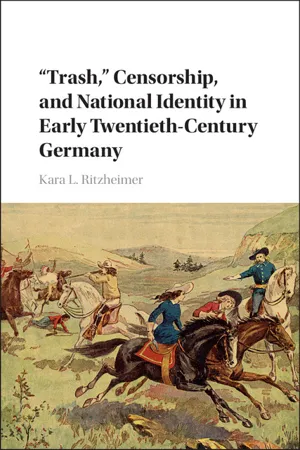
Convinced that sexual immorality and unstable gender norms were endangering national recovery after World War One, German lawmakers drafted a constitution in 1919 legalizing the censorship of movies and pulp fiction, and prioritizing social rights over individual rights. These provisions enabled legislations to adopt two national censorship laws intended to regulate the movie industry and retail trade in pulp fiction. Both laws had their ideological origins in grass-roots anti-'trash' campaigns inspired by early encounters with commercial mass culture and Germany's federalist structure. Before the war, activists characterized censorship as a form of youth protection. Afterwards, they described it as a form of social welfare. Local activists and authorities enforcing the decisions of federal censors made censorship familiar and respectable even as these laws became a lightning rod for criticism of the young republic. Nazi leaders subsequently refashioned anti-'trash' rhetoric to justify the stringent censorship regime they imposed on Germany.
Information
Table of contents
- Cover
- Half-title page
- Title page
- Copyright page
- Dedication
- Contents
- Acknowledgments
- Introduction Censorship in the Rechtsstaat, Censorship in the Sozialstaat
- 1 Buffalo Bill in Germany: Regional Encounters with Commercial Culture before WWI
- 2 Federalism and Censorship: Regulating Commercial Fiction and Movies in Imperial Germany
- 3 Censorship in the Rechtsstaat: Anti-“Trash” Rhetoric and National Identity in Imperial Germany
- 4 Censorship and “Trash” in Wartime Germany
- 5 Censorship in the Sozialstaat: Weimar’s Film and Publications Laws
- 6 Censorship, Morality, and National Identity in Weimar Germany
- Epilogue Schund and Schmutz in the Third Reich and the Federal Republic of Germany
- Bibliography
- Index
Trusted by 375,005 students
Access to over 1.5 million titles for a fair monthly price.
Study more efficiently using our study tools.
Frequently asked questions
Yes, you can cancel anytime from the Subscription tab in your account settings on the Perlego website. Your subscription will stay active until the end of your current billing period. Learn how to cancel your subscription
No, books cannot be downloaded as external files, such as PDFs, for use outside of Perlego. However, you can download books within the Perlego app for offline reading on mobile or tablet. Learn how to download books offline
Perlego offers two plans: Essential and Complete
- Essential is ideal for learners and professionals who enjoy exploring a wide range of subjects. Access the Essential Library with 800,000+ trusted titles and best-sellers across business, personal growth, and the humanities. Includes unlimited reading time and Standard Read Aloud voice.
- Complete: Perfect for advanced learners and researchers needing full, unrestricted access. Unlock 1.5M+ books across hundreds of subjects, including academic and specialized titles. The Complete Plan also includes advanced features like Premium Read Aloud and Research Assistant.
We are an online textbook subscription service, where you can get access to an entire online library for less than the price of a single book per month. With over 1.5 million books across 990+ topics, we’ve got you covered! Learn about our mission
Look out for the read-aloud symbol on your next book to see if you can listen to it. The read-aloud tool reads text aloud for you, highlighting the text as it is being read. You can pause it, speed it up and slow it down. Learn more about Read Aloud
Yes! You can use the Perlego app on both iOS and Android devices to read anytime, anywhere — even offline. Perfect for commutes or when you’re on the go.
Please note we cannot support devices running on iOS 13 and Android 7 or earlier. Learn more about using the app
Please note we cannot support devices running on iOS 13 and Android 7 or earlier. Learn more about using the app
Yes, you can access 'Trash,' Censorship, and National Identity in Early Twentieth-Century Germany by Kara L. Ritzheimer in PDF and/or ePUB format, as well as other popular books in History & European History. We have over 1.5 million books available in our catalogue for you to explore.