- 332 pages
- English
- PDF
- Available on iOS & Android
eBook - PDF
About this book
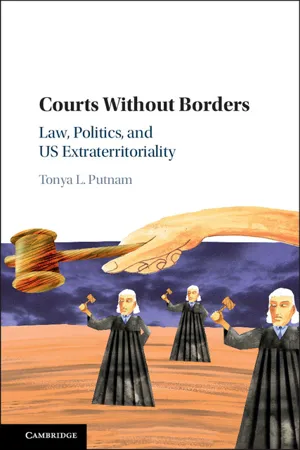
Courts without Borders is the first book to examine the politics of judicial extraterritoriality, with a focus on the world's chief practitioner: the United States. For much of the post-World War II era, the United States has been a frequent yet selective regulator of activities outside its territory, and US federal courts are often on the front line in deciding the extraterritorial reach of US law. At stake in these jurisdiction battles is the ability to bring the regulatory power of the United States to bear on transnational disputes in ways that other states frequently dislike both in principle and in practice. This volume proposes a general theory of domestic court behavior to explain variation in extraterritorial enforcement of US law, emphasizing how the strategic behavior of private actors is important to mobilizing courts and in directing their activities.
Information
Table of contents
- Cover
- Half-title page
- Title page
- Copyright page
- Contents
- List of figures
- List of tables
- Acknowledgments
- 1 Courts without borders
- 2 A theory of judicial extraterritoriality
- 3 Domestic courts and transnational governance
- 4 Extraterritoriality in the absence of agreement: International antitrust
- 5 Extraterritoriality’s limits and U.S. bargaining over intellectual property protection
- 6 U.S. extraterritoriality and human rights: Shaping a regime from within
- 7 The waning of U.S. extraterritoriality?
- Bibliography
- Index
Trusted by 375,005 students
Access to over 1.5 million titles for a fair monthly price.
Study more efficiently using our study tools.
Frequently asked questions
Yes, you can cancel anytime from the Subscription tab in your account settings on the Perlego website. Your subscription will stay active until the end of your current billing period. Learn how to cancel your subscription
No, books cannot be downloaded as external files, such as PDFs, for use outside of Perlego. However, you can download books within the Perlego app for offline reading on mobile or tablet. Learn how to download books offline
Perlego offers two plans: Essential and Complete
- Essential is ideal for learners and professionals who enjoy exploring a wide range of subjects. Access the Essential Library with 800,000+ trusted titles and best-sellers across business, personal growth, and the humanities. Includes unlimited reading time and Standard Read Aloud voice.
- Complete: Perfect for advanced learners and researchers needing full, unrestricted access. Unlock 1.5M+ books across hundreds of subjects, including academic and specialized titles. The Complete Plan also includes advanced features like Premium Read Aloud and Research Assistant.
We are an online textbook subscription service, where you can get access to an entire online library for less than the price of a single book per month. With over 1.5 million books across 990+ topics, we’ve got you covered! Learn about our mission
Look out for the read-aloud symbol on your next book to see if you can listen to it. The read-aloud tool reads text aloud for you, highlighting the text as it is being read. You can pause it, speed it up and slow it down. Learn more about Read Aloud
Yes! You can use the Perlego app on both iOS and Android devices to read anytime, anywhere — even offline. Perfect for commutes or when you’re on the go.
Please note we cannot support devices running on iOS 13 and Android 7 or earlier. Learn more about using the app
Please note we cannot support devices running on iOS 13 and Android 7 or earlier. Learn more about using the app
Yes, you can access Courts without Borders by Tonya L. Putnam in PDF and/or ePUB format, as well as other popular books in Law & International Law. We have over 1.5 million books available in our catalogue for you to explore.