- 277 pages
- English
- PDF
- Available on iOS & Android
eBook - PDF
About this book
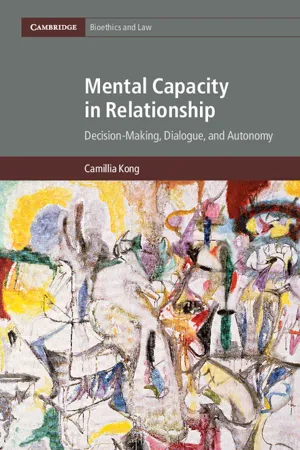
Recent legal developments challenge how valid the concept of mental capacity is in determining whether individuals with impairments can make decisions about their care and treatment. Kong defends a concept of mental capacity but argues that such assessments must consider how relationships and dialogue can enable or disable the decision-making abilities of these individuals. This is thoroughly investigated using an interdisciplinary approach that combines philosophy and legal analysis of the law in England and Wales, the European Court of Human Rights, and the United Nations Convention on the Rights of Persons with Disabilities. By exploring key concepts underlying mental capacity, the investigation concludes that both primary relationships and capacity assessments themselves must display key competencies to ensure that autonomy skills are promoted and encouraged. This ultimately provides scope for justifiable interventions into disabling relationships and articulates the dialogical practices that help better situate, interpret, and understand the choices and actions of individuals with impairments.
Information
Table of contents
- Cover
- Half title
- Series
- Title
- Copyright
- Dedication
- Contents
- Acknowledgements
- List of Statutes
- List of Cases
- 1 Problems with Mental Capacity
- 2 Mental Capacity, Legal Capacity, and Relational Rights
- 3 Relational Autonomy and the Promotion of Decisional Capacity
- 4 Procedural Reasoning and the Social Space of Reasons in Capacity Assessments
- 5 Ethical Duties of Support and Intervention
- 6 Hermeneutic Competence and the Dialogical Conditions of Capacity
- 7 Rethinking Capacity
- Appendix 1 Overview of the Mental Capacity Act 2005 and Inherent Jurisdiction in England and Wales
- Bibliography
- Index
Trusted by 375,005 students
Access to over 1.5 million titles for a fair monthly price.
Study more efficiently using our study tools.
Frequently asked questions
Yes, you can cancel anytime from the Subscription tab in your account settings on the Perlego website. Your subscription will stay active until the end of your current billing period. Learn how to cancel your subscription
No, books cannot be downloaded as external files, such as PDFs, for use outside of Perlego. However, you can download books within the Perlego app for offline reading on mobile or tablet. Learn how to download books offline
Perlego offers two plans: Essential and Complete
- Essential is ideal for learners and professionals who enjoy exploring a wide range of subjects. Access the Essential Library with 800,000+ trusted titles and best-sellers across business, personal growth, and the humanities. Includes unlimited reading time and Standard Read Aloud voice.
- Complete: Perfect for advanced learners and researchers needing full, unrestricted access. Unlock 1.5M+ books across hundreds of subjects, including academic and specialized titles. The Complete Plan also includes advanced features like Premium Read Aloud and Research Assistant.
We are an online textbook subscription service, where you can get access to an entire online library for less than the price of a single book per month. With over 1.5 million books across 990+ topics, we’ve got you covered! Learn about our mission
Look out for the read-aloud symbol on your next book to see if you can listen to it. The read-aloud tool reads text aloud for you, highlighting the text as it is being read. You can pause it, speed it up and slow it down. Learn more about Read Aloud
Yes! You can use the Perlego app on both iOS and Android devices to read anytime, anywhere — even offline. Perfect for commutes or when you’re on the go.
Please note we cannot support devices running on iOS 13 and Android 7 or earlier. Learn more about using the app
Please note we cannot support devices running on iOS 13 and Android 7 or earlier. Learn more about using the app
Yes, you can access Mental Capacity in Relationship by Camillia Kong in PDF and/or ePUB format, as well as other popular books in Law & Medical Law. We have over 1.5 million books available in our catalogue for you to explore.