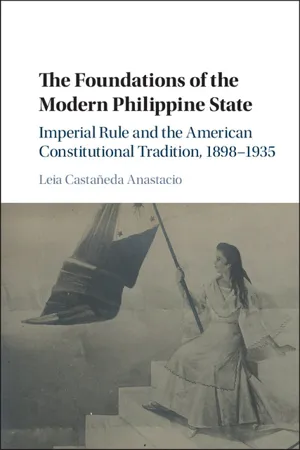
eBook - PDF
The Foundations of the Modern Philippine State
Imperial Rule and the American Constitutional Tradition in the Philippine Islands, 1898–1935
- 342 pages
- English
- PDF
- Available on iOS & Android
eBook - PDF
The Foundations of the Modern Philippine State
Imperial Rule and the American Constitutional Tradition in the Philippine Islands, 1898–1935
About this book
The US occupation of the Philippine Islands in 1898 began a foundational period of the modern Philippine state. With the adoption of the 1935 Philippine Constitution, the legal conventions for ultimate independence were in place. In this time, American officials and their Filipino elite collaborators established a representative, progressive, yet limited colonial government that would modernize the Philippine Islands through colonial democracy and developmental capitalism. Examining constitutional discourse in American and Philippine government records, academic literature, newspaper and personal accounts, The Foundations of the Modern Philippine State concludes that the promise of America's liberal empire was negated by the imperative of insulating American authority from Filipino political demands. Premised on Filipino incapacity, the colonial constitution weakened the safeguards that shielded liberty from power and unleashed liberalism's latent tyrannical potential in the name of civilization. This forged a constitutional despotism that haunts the Islands to this day.
Information
Table of contents
- Cover
- Half title
- Series
- Title
- Copyright
- Dedication
- Contents
- Acknowledgements
- Introduction
- 1 Republican Means, Imperial Ends: American Empire and the Rule of Law
- 2 American Theory, Spanish Structure, and Ilustrado Capacity: Inventing the Filipino People, Constructing the American Colonial State
- 3 Foreign in a Domestic Sense: Organic Sovereignty, Unincorporated Territories, and the Insular Doctrine
- 4 Sovereign but not Popular: Colonial Leviathan, Inherent Power, and Plenary Authority
- 5 Progressive Interventions, Parchment Barriers: Civilizing Mission, Colonial Development, and Constitutional Limitations
- 6 Popular but not Sovereign: Colonial Democracy and the Rise of the Philippine Assembly
- 7 American Vessels, Filipino Spirit: Filipinizing the Government of the Philippine Islands
- 8 Filipinizing the Public: The Business of Government and the Government in Business
- 9 Progressivism, Populism, and the Public Interest: Restoring the Taft Era and the Cabinet Crisis of 1923
- 10 Colonial Conflict, Constitutional Categories: Constitutional Imperialism and the Board of Control Cases
- 11 From "Is" to "Ought": Constitutionalizing Colonial Legacies
- Conclusion
- Notes
- Index
Trusted by 375,005 students
Access to over 1.5 million titles for a fair monthly price.
Study more efficiently using our study tools.
Frequently asked questions
Yes, you can cancel anytime from the Subscription tab in your account settings on the Perlego website. Your subscription will stay active until the end of your current billing period. Learn how to cancel your subscription
No, books cannot be downloaded as external files, such as PDFs, for use outside of Perlego. However, you can download books within the Perlego app for offline reading on mobile or tablet. Learn how to download books offline
Perlego offers two plans: Essential and Complete
- Essential is ideal for learners and professionals who enjoy exploring a wide range of subjects. Access the Essential Library with 800,000+ trusted titles and best-sellers across business, personal growth, and the humanities. Includes unlimited reading time and Standard Read Aloud voice.
- Complete: Perfect for advanced learners and researchers needing full, unrestricted access. Unlock 1.5M+ books across hundreds of subjects, including academic and specialized titles. The Complete Plan also includes advanced features like Premium Read Aloud and Research Assistant.
We are an online textbook subscription service, where you can get access to an entire online library for less than the price of a single book per month. With over 1.5 million books across 990+ topics, we’ve got you covered! Learn about our mission
Look out for the read-aloud symbol on your next book to see if you can listen to it. The read-aloud tool reads text aloud for you, highlighting the text as it is being read. You can pause it, speed it up and slow it down. Learn more about Read Aloud
Yes! You can use the Perlego app on both iOS and Android devices to read anytime, anywhere — even offline. Perfect for commutes or when you’re on the go.
Please note we cannot support devices running on iOS 13 and Android 7 or earlier. Learn more about using the app
Please note we cannot support devices running on iOS 13 and Android 7 or earlier. Learn more about using the app
Yes, you can access The Foundations of the Modern Philippine State by Leia Castañeda Anastacio in PDF and/or ePUB format, as well as other popular books in History & North American History. We have over 1.5 million books available in our catalogue for you to explore.