- 312 pages
- English
- PDF
- Available on iOS & Android
eBook - PDF
About this book
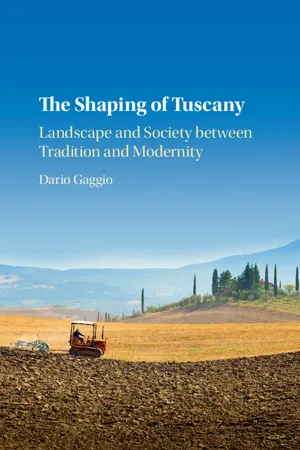
To its many tourists and visitors, the Tuscan landscape evokes a sense of timelessness and harmony. Yet, the upheavals of the twentieth century profoundly reshaped rural Tuscany. Uncovering the experiences of ordinary people, Professor Gaggio traces the history of Tuscany to show how the region's modern conflicts and aspirations have contributed to forging its modern-day beauty. He demonstrates how the rise of Fascism was particularly violent in rural Tuscany, and how struggles between Communist sharecroppers and their landlords raged long after the end of the dictatorship. The flight from the farms in the 1950s and 1960s disorientated many Tuscans, prompting ambitious development projects, and in more recent decades the emergence of the heritage industry has raised the spectre of commodification. This book tells the story of how many Tuscans themselves have become tourists in their own land – forced to adapt to rapid change and reinvent their landscape in the process.
Information
Table of contents
- Cover
- Half-title
- Title page
- Copyright information
- Table of contents
- Acknowledgments
- Introduction
- 1 Land, Nation, Race: Reclaiming Tuscany’s Hill Country under Fascism (1929–1944)
- 2 Newer Beginnings: The Landscape of Social Strife (1945–1956)
- 3 Left Behind: The Rural Exodus (1957–1970)
- 4 The Uses of Emptiness: Rural Tuscany after the Exodus (1970–1985)
- 5 The Farmhouse and the Museum: Rural Tuscany as Patrimony
- 6 Searching for the Bel Paesaggio: Norming and Litigating the Landscape
- Conclusion
- Index
Trusted by 375,005 students
Access to over 1.5 million titles for a fair monthly price.
Study more efficiently using our study tools.
Frequently asked questions
Yes, you can cancel anytime from the Subscription tab in your account settings on the Perlego website. Your subscription will stay active until the end of your current billing period. Learn how to cancel your subscription
No, books cannot be downloaded as external files, such as PDFs, for use outside of Perlego. However, you can download books within the Perlego app for offline reading on mobile or tablet. Learn how to download books offline
Perlego offers two plans: Essential and Complete
- Essential is ideal for learners and professionals who enjoy exploring a wide range of subjects. Access the Essential Library with 800,000+ trusted titles and best-sellers across business, personal growth, and the humanities. Includes unlimited reading time and Standard Read Aloud voice.
- Complete: Perfect for advanced learners and researchers needing full, unrestricted access. Unlock 1.5M+ books across hundreds of subjects, including academic and specialized titles. The Complete Plan also includes advanced features like Premium Read Aloud and Research Assistant.
We are an online textbook subscription service, where you can get access to an entire online library for less than the price of a single book per month. With over 1.5 million books across 990+ topics, we’ve got you covered! Learn about our mission
Look out for the read-aloud symbol on your next book to see if you can listen to it. The read-aloud tool reads text aloud for you, highlighting the text as it is being read. You can pause it, speed it up and slow it down. Learn more about Read Aloud
Yes! You can use the Perlego app on both iOS and Android devices to read anytime, anywhere — even offline. Perfect for commutes or when you’re on the go.
Please note we cannot support devices running on iOS 13 and Android 7 or earlier. Learn more about using the app
Please note we cannot support devices running on iOS 13 and Android 7 or earlier. Learn more about using the app
Yes, you can access The Shaping of Tuscany by Dario Gaggio in PDF and/or ePUB format, as well as other popular books in History & European History. We have over 1.5 million books available in our catalogue for you to explore.