- 354 pages
- English
- PDF
- Available on iOS & Android
eBook - PDF
Sovereignty, International Law, and the French Revolution
About this book
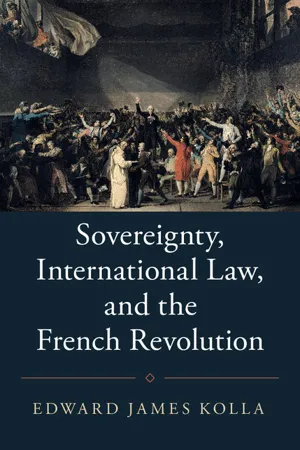
The advent of the principle of popular sovereignty during the French Revolution inspired an unintended but momentous change in international law. Edward James Kolla explains that between 1789 and 1799, the idea that peoples ought to determine their fates in international affairs, just as they were taking power domestically in France, inspired a series of new and interconnected claims to territory. Drawing on case studies from Avignon, Belgium, the Rhineland, the Netherlands, Switzerland, and Italy, Kolla traces how French revolutionary diplomats and leaders gradually applied principles derived from new domestic political philosophy and law to the international stage. Instead of obtaining land via dynastic inheritance or conquest in war, the will of the people would now determine the title and status of territory. However, the principle of popular sovereignty also opened up new justifications for aggressive conquest, and this history foreshadowed some of the most controversial questions in international relations today.
Information
Table of contents
- Cover
- Half-title page
- Series page
- Title page
- Copyright page
- Dedication
- Contents
- List of Maps
- Acknowledgments
- Introduction
- 1 Popular Sovereignty and International Law on the Periphery of France
- 2 The Union of Avignon and the Challenges of Self-Determination
- 3 Revolutionary Power and the Annexation of Belgium
- 4 Strategic Interests, Survival, and the Left Bank of the Rhine
- 5 Between Subject and Sovereign States: Sister Republics in the Netherlands, Switzerland, and Italy
- Conclusion
- Select Bibliography
- Index
Trusted by 375,005 students
Access to over 1.5 million titles for a fair monthly price.
Study more efficiently using our study tools.
Frequently asked questions
Yes, you can cancel anytime from the Subscription tab in your account settings on the Perlego website. Your subscription will stay active until the end of your current billing period. Learn how to cancel your subscription
No, books cannot be downloaded as external files, such as PDFs, for use outside of Perlego. However, you can download books within the Perlego app for offline reading on mobile or tablet. Learn how to download books offline
Perlego offers two plans: Essential and Complete
- Essential is ideal for learners and professionals who enjoy exploring a wide range of subjects. Access the Essential Library with 800,000+ trusted titles and best-sellers across business, personal growth, and the humanities. Includes unlimited reading time and Standard Read Aloud voice.
- Complete: Perfect for advanced learners and researchers needing full, unrestricted access. Unlock 1.5M+ books across hundreds of subjects, including academic and specialized titles. The Complete Plan also includes advanced features like Premium Read Aloud and Research Assistant.
We are an online textbook subscription service, where you can get access to an entire online library for less than the price of a single book per month. With over 1.5 million books across 990+ topics, we’ve got you covered! Learn about our mission
Look out for the read-aloud symbol on your next book to see if you can listen to it. The read-aloud tool reads text aloud for you, highlighting the text as it is being read. You can pause it, speed it up and slow it down. Learn more about Read Aloud
Yes! You can use the Perlego app on both iOS and Android devices to read anytime, anywhere — even offline. Perfect for commutes or when you’re on the go.
Please note we cannot support devices running on iOS 13 and Android 7 or earlier. Learn more about using the app
Please note we cannot support devices running on iOS 13 and Android 7 or earlier. Learn more about using the app
Yes, you can access Sovereignty, International Law, and the French Revolution by Edward James Kolla in PDF and/or ePUB format, as well as other popular books in History & European History. We have over 1.5 million books available in our catalogue for you to explore.