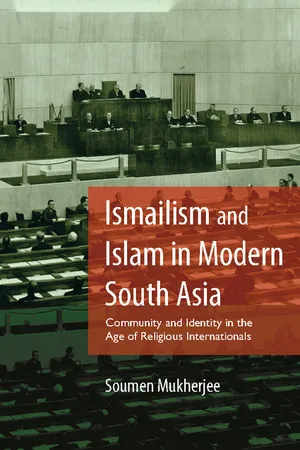
eBook - PDF
Ismailism and Islam in Modern South Asia
Community and Identity in the Age of Religious Internationals
- 220 pages
- English
- PDF
- Available on iOS & Android
eBook - PDF
Ismailism and Islam in Modern South Asia
Community and Identity in the Age of Religious Internationals
About this book
This book explores the evolution of a Shia Ismaili identity and crucial aspects of the historical forces that conditioned the development of the Muslim modern in late colonial South Asia. It traces the legal process that, since the 1860s, recast a Shia Imami identity for the Ismailis, and explicates the public career of Imam Aga Khan III amid heightened religious internationalism since the late-nineteenth century, the age of 'religious internationals'. It sheds light and elaborates on the enduring legacies of questions such as the Aga's understanding of colonial modernity, his ideas of India, restructured modalities of community governance and the evolution of Imamate-sponsored institutions, key strands in scholarship that characterized the development of the Muslim and Shia Ismaili modern, and Muslim universality vis-à-vis denominational particularities that often transcended the remits of the modular nation and state structure.
Information
Topic
Theology & ReligionSubtopic
Islamic TheologyTable of contents
- Cover
- Ismailism and Islam in Modern South Asia
- Title
- Copyright
- Contents
- Acknowledgements
- List of Abbreviations
- Glossary
- Note on Transliteration
- Introduction
- 1 The Khoja Ismailis and Legal Polemics: Religion and Customs in Nineteenth Century Bombay
- 2 The Howardian Moment: Morality, Aryanism and Scholarship
- 3 Pan-Islamism and an Asiatic Spirit: Postnational Subjectivities in an Age of ‘Transition’
- 4 The Hazir Imam, Ismailism and Islam in Late Colonial South Asia
- 5 The Importance of Being Ismaili: Religious Normativity and the Ismaili International in the Age of Global Assemblages
- Concluding Reflections
- Select Bibliography
- Index
Trusted by 375,005 students
Access to over 1.5 million titles for a fair monthly price.
Study more efficiently using our study tools.
Frequently asked questions
Yes, you can cancel anytime from the Subscription tab in your account settings on the Perlego website. Your subscription will stay active until the end of your current billing period. Learn how to cancel your subscription
No, books cannot be downloaded as external files, such as PDFs, for use outside of Perlego. However, you can download books within the Perlego app for offline reading on mobile or tablet. Learn how to download books offline
Perlego offers two plans: Essential and Complete
- Essential is ideal for learners and professionals who enjoy exploring a wide range of subjects. Access the Essential Library with 800,000+ trusted titles and best-sellers across business, personal growth, and the humanities. Includes unlimited reading time and Standard Read Aloud voice.
- Complete: Perfect for advanced learners and researchers needing full, unrestricted access. Unlock 1.5M+ books across hundreds of subjects, including academic and specialized titles. The Complete Plan also includes advanced features like Premium Read Aloud and Research Assistant.
We are an online textbook subscription service, where you can get access to an entire online library for less than the price of a single book per month. With over 1.5 million books across 990+ topics, we’ve got you covered! Learn about our mission
Look out for the read-aloud symbol on your next book to see if you can listen to it. The read-aloud tool reads text aloud for you, highlighting the text as it is being read. You can pause it, speed it up and slow it down. Learn more about Read Aloud
Yes! You can use the Perlego app on both iOS and Android devices to read anytime, anywhere — even offline. Perfect for commutes or when you’re on the go.
Please note we cannot support devices running on iOS 13 and Android 7 or earlier. Learn more about using the app
Please note we cannot support devices running on iOS 13 and Android 7 or earlier. Learn more about using the app
Yes, you can access Ismailism and Islam in Modern South Asia by Soumen Mukherjee in PDF and/or ePUB format, as well as other popular books in Theology & Religion & Islamic Theology. We have over 1.5 million books available in our catalogue for you to explore.