- 346 pages
- English
- PDF
- Available on iOS & Android
eBook - PDF
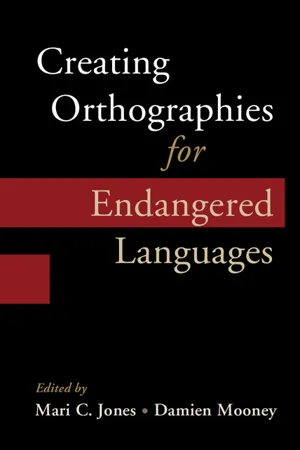
Creating Orthographies for Endangered Languages
About this book
Creating an orthography is often seen as a key component of language revitalisation. Encoding an endangered variety can enhance its status and prestige. In speech communities that are fragmented dialectally or geographically, a common writing system may help create a sense of unified identity, or help keep a language alive by facilitating teaching and learning. Despite clear advantages, creating an orthography for an endangered language can also bring challenges, and this volume debates the following critical questions: whose task should this be - that of the linguist or the speech community? Should an orthography be maximally distanciated from that of the language of wider communication for ideological reasons, or should its main principles coincide for reasons of learnability? Which local variety should be selected as the basis of a common script? Is a multilectal script preferable to a standardised orthography? And can creating an orthography create problems for existing native speakers?
Information
Table of contents
- Cover
- Half-title page
- Title page
- Copyright page
- Dedication
- Contents
- List of Contributors
- 1 Creating Orthographies for Endangered Languages
- 2 Who Owns Vernacular Literacy? Assessing the Sustainability of Written Vernaculars
- 3 Hearing Local Voices, Creating Local Content: Participatory Approaches in Orthography Development for Non-Dominant Language Communities
- 4 Orthographies ‘In the Making’: The Dynamic Construction of Community-Based Writing Systems among the Náayeri of North-Western Mexico
- 5 Community-Driven, Goal-Centred Orthography Development: A Tsakhur Case Study
- 6 Writing for Speaking: The Nǀuu Orthography
- 7 Reflections on the Kala Biŋatuwã, a Three-Year-Old Alphabet from Papua New Guinea
- 8 When Letters Represent More Than Sounds: Ideology versus Practicality in the Development of a Standard Orthography for Ch’orti’ Mayan
- 9 The Difficult Task of Finding a Standard Writing System for the Sioux Languages
- 10 Orthography Development in Sardinia: The Case of Limba Sarda Comuna
- 11 Breton Orthographies: An Increasingly Awkward Fit
- 12 Spelling Trouble: Ideologies and Practices in Giernesiei/Dgernesiais/Guernesiais/Guernésiais/Djernezié …
- 13 Orthography Development on the Internet: Romani on YouTube
- 14 Orthography Creation for Postvernacular Languages: Case Studies of Rama and Francoprovençal Revitalization
- 15 Changing Script in a Threatened Language: Reactions to Romanization at Bantia in the First Century BC
- Bibliography
- Index
Trusted by 375,005 students
Access to over 1.5 million titles for a fair monthly price.
Study more efficiently using our study tools.
Frequently asked questions
Yes, you can cancel anytime from the Subscription tab in your account settings on the Perlego website. Your subscription will stay active until the end of your current billing period. Learn how to cancel your subscription
No, books cannot be downloaded as external files, such as PDFs, for use outside of Perlego. However, you can download books within the Perlego app for offline reading on mobile or tablet. Learn how to download books offline
Perlego offers two plans: Essential and Complete
- Essential is ideal for learners and professionals who enjoy exploring a wide range of subjects. Access the Essential Library with 800,000+ trusted titles and best-sellers across business, personal growth, and the humanities. Includes unlimited reading time and Standard Read Aloud voice.
- Complete: Perfect for advanced learners and researchers needing full, unrestricted access. Unlock 1.5M+ books across hundreds of subjects, including academic and specialized titles. The Complete Plan also includes advanced features like Premium Read Aloud and Research Assistant.
We are an online textbook subscription service, where you can get access to an entire online library for less than the price of a single book per month. With over 1.5 million books across 990+ topics, we’ve got you covered! Learn about our mission
Look out for the read-aloud symbol on your next book to see if you can listen to it. The read-aloud tool reads text aloud for you, highlighting the text as it is being read. You can pause it, speed it up and slow it down. Learn more about Read Aloud
Yes! You can use the Perlego app on both iOS and Android devices to read anytime, anywhere — even offline. Perfect for commutes or when you’re on the go.
Please note we cannot support devices running on iOS 13 and Android 7 or earlier. Learn more about using the app
Please note we cannot support devices running on iOS 13 and Android 7 or earlier. Learn more about using the app
Yes, you can access Creating Orthographies for Endangered Languages by Mari C. Jones,Damien Mooney in PDF and/or ePUB format, as well as other popular books in Languages & Linguistics & Linguistics. We have over 1.5 million books available in our catalogue for you to explore.