eBook - PDF
The Art of Astrophotography
About this book
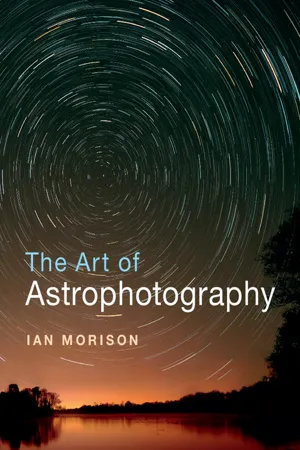
In The Art of Astrophotography, astronomer and Popular Astronomy columnist Ian Morison provides the essential foundations of how to produce beautiful astronomical images. Every type of astroimaging is covered, from images of the Moon and planets, to the constellations, star clusters and nebulae within our Milky Way Galaxy and the faint light of distant galaxies. He achieves this through a series of worked examples and short project walk-throughs, detailing the equipment needed – starting with just a DSLR (digital single lens reflex) camera and tripod, and increasing in complexity as the book progresses - followed by the way to best capture the images and then how, step by step, these may be processed and enhanced to provide results that can rival those seen in astronomical magazines and books. Whether you are just getting into astrophotography or are already deeply involved, Morison's advice will help you capture and create enticing astronomical images.
Information
Topic
Physical SciencesSubtopic
Astronomy & AstrophysicsTable of contents
- Cover
- Half-title
- Title page
- Copyright information
- Dedication
- Table of contents
- Preface
- Acknowledgements
- 1 Imaging Star Trails
- 2 Imaging a Constellation with a DSLR and Tripod
- 3 Imaging the Milky Way with a DSLR and Tracking Mount
- 4 Imaging the Moon with a Compact Camera or Smartphone
- 5 Imaging the Moon with a DSLR
- 6 Imaging the Pleiades Cluster with a DSLR and Small Refractor
- 7 Imaging the Orion Nebula, M42, with a Modified Canon DSLR
- 8 Telescopes and Their Accessories for Use in Astroimaging
- 9 Towards Stellar Excellence
- 10 Cooling a DSLR Camera to Reduce Sensor Noise
- 11 Imaging the North America and Pelican Nebulae
- 12 Combating Light Pollution – the Bane of Astrophotographers
- 13 Imaging Planets with an Astronomical Video Camera or Canon DSLR
- 14 Video Imaging of the Moon with a Webcam or DSLR
- 15 Imaging the Sun in White Light
- 16 Imaging the Sun in the Light of its H-alpha Emission
- 17 Imaging Meteors
- 18 Imaging Comets
- 19 Using a Cooled ‘One Shot Colour’ Camera
- 20 Cooled Monochrome CCD Cameras
- 21 LRGB Colour Imaging
- 22 Narrowband Colour Imaging
- Appendix A: Telescopes for Imaging
- Appendix B: Telescope Mounts
- Appendix C: The Effects of the Atmosphere
- Appendix D: Autoguiding
- Appendix E: Image Calibration
- Appendix F: Practical Aspects of Astroimaging
- Appendix G: A Survey of Astronomical Websites and Instructional DVDs
- Index
Trusted by 375,005 students
Access to over 1.5 million titles for a fair monthly price.
Study more efficiently using our study tools.
Frequently asked questions
Yes, you can cancel anytime from the Subscription tab in your account settings on the Perlego website. Your subscription will stay active until the end of your current billing period. Learn how to cancel your subscription
No, books cannot be downloaded as external files, such as PDFs, for use outside of Perlego. However, you can download books within the Perlego app for offline reading on mobile or tablet. Learn how to download books offline
Perlego offers two plans: Essential and Complete
- Essential is ideal for learners and professionals who enjoy exploring a wide range of subjects. Access the Essential Library with 800,000+ trusted titles and best-sellers across business, personal growth, and the humanities. Includes unlimited reading time and Standard Read Aloud voice.
- Complete: Perfect for advanced learners and researchers needing full, unrestricted access. Unlock 1.5M+ books across hundreds of subjects, including academic and specialized titles. The Complete Plan also includes advanced features like Premium Read Aloud and Research Assistant.
We are an online textbook subscription service, where you can get access to an entire online library for less than the price of a single book per month. With over 1.5 million books across 990+ topics, we’ve got you covered! Learn about our mission
Look out for the read-aloud symbol on your next book to see if you can listen to it. The read-aloud tool reads text aloud for you, highlighting the text as it is being read. You can pause it, speed it up and slow it down. Learn more about Read Aloud
Yes! You can use the Perlego app on both iOS and Android devices to read anytime, anywhere — even offline. Perfect for commutes or when you’re on the go.
Please note we cannot support devices running on iOS 13 and Android 7 or earlier. Learn more about using the app
Please note we cannot support devices running on iOS 13 and Android 7 or earlier. Learn more about using the app
Yes, you can access The Art of Astrophotography by Ian Morison in PDF and/or ePUB format, as well as other popular books in Physical Sciences & Astronomy & Astrophysics. We have over 1.5 million books available in our catalogue for you to explore.