eBook - PDF
Eating Nature in Modern Germany
Food, Agriculture and Environment, c.1870 to 2000
- 406 pages
- English
- PDF
- Available on iOS & Android
eBook - PDF
About this book
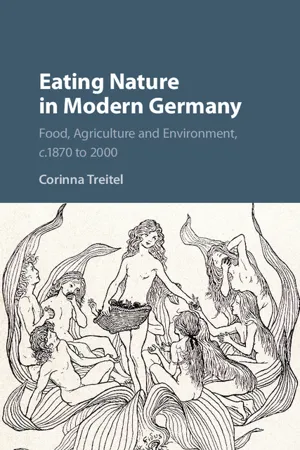
Adolf Hitler was a vegetarian and the Dachau concentration camp had an organic herb garden. Vegetarianism, organic farming, and other such practices have enticed a wide variety of Germans, from socialists, liberals, and radical anti-Semites in the nineteenth century to fascists, communists, and Greens in the twentieth century. Corinna Treitel offers a fascinating new account of how Germans became world leaders in developing more 'natural' ways to eat and farm. Used to conserve nutritional resources with extreme efficiency at times of hunger and to optimize the nation's health at times of nutritional abundance, natural foods and farming belong to the biopolitics of German modernity. Eating Nature in Modern Germany brings together histories of science, medicine, agriculture, the environment, and popular culture to offer the most thorough and historically comprehensive treatment yet of this remarkable story.
Information
Table of contents
- Cover
- Half-title
- Title page
- Copyright information
- Table of contents
- List of illustrations
- List of charts and tables
- Acknowledgments
- Translations and abbreviations
- Introduction
- 1 Hunger, Citizenship, and the Gospel of Nature
- 2 Being Natural
- 3 Nature and the Nutrition Question in Imperial and Weimar Germany
- 4 Humans Are Only Plants in Nature’s Garden
- 5 Nature and the Nazi Diet
- 6 Mainstreaming Nature, Pursuing Health
- 7 Masking Nature, Prescribing Health
- Conclusion
- Appendix I: Selected Periodicals
- Appendix II: Selected Cookbooks and Nutritional Guides, 1869–1945
- Appendix III: Selected Institutions of Nutritional Research and Education
- Appendix IV: Biographical Information on Key Figures in Chapters 5, 6, and 7
- Appendix V: Supplementary Tables for Chapters 5, 6, and 7
- Selected Bibliography
- Index
Trusted by 375,005 students
Access to over 1.5 million titles for a fair monthly price.
Study more efficiently using our study tools.
Frequently asked questions
Yes, you can cancel anytime from the Subscription tab in your account settings on the Perlego website. Your subscription will stay active until the end of your current billing period. Learn how to cancel your subscription
No, books cannot be downloaded as external files, such as PDFs, for use outside of Perlego. However, you can download books within the Perlego app for offline reading on mobile or tablet. Learn how to download books offline
Perlego offers two plans: Essential and Complete
- Essential is ideal for learners and professionals who enjoy exploring a wide range of subjects. Access the Essential Library with 800,000+ trusted titles and best-sellers across business, personal growth, and the humanities. Includes unlimited reading time and Standard Read Aloud voice.
- Complete: Perfect for advanced learners and researchers needing full, unrestricted access. Unlock 1.5M+ books across hundreds of subjects, including academic and specialized titles. The Complete Plan also includes advanced features like Premium Read Aloud and Research Assistant.
We are an online textbook subscription service, where you can get access to an entire online library for less than the price of a single book per month. With over 1.5 million books across 990+ topics, we’ve got you covered! Learn about our mission
Look out for the read-aloud symbol on your next book to see if you can listen to it. The read-aloud tool reads text aloud for you, highlighting the text as it is being read. You can pause it, speed it up and slow it down. Learn more about Read Aloud
Yes! You can use the Perlego app on both iOS and Android devices to read anytime, anywhere — even offline. Perfect for commutes or when you’re on the go.
Please note we cannot support devices running on iOS 13 and Android 7 or earlier. Learn more about using the app
Please note we cannot support devices running on iOS 13 and Android 7 or earlier. Learn more about using the app
Yes, you can access Eating Nature in Modern Germany by Corinna Treitel in PDF and/or ePUB format, as well as other popular books in History & European History. We have over 1.5 million books available in our catalogue for you to explore.