- 254 pages
- English
- PDF
- Available on iOS & Android
eBook - PDF
About this book
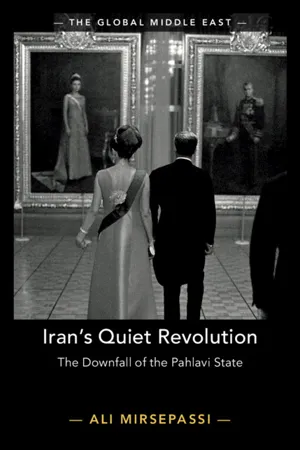
Offering a new perspective on Iran's politics and culture in the 1960s and 1970s, Ali Mirsepassi challenges the prevailing view of pre-Revolution Iran, documenting how the cultural elites of the Pahlavi State promoted a series of striking 'Gharbzadegi' or 'Westoxification' discourses. Intended as ideological alternatives to modern and Western-inspired cultural attitudes, these influenced Persian identity politics, and projected Iranian modernity as a 'mistaken modernity' despite the regime's own ferocious modernisation programme. Focusing on the cultural transformations which defined the period, Mirsepassi sheds new light on the Pahlavi State as an ideological gambler, inadvertently empowering its fundamentalist enemies and spreading a 'quiet revolution' through secular and religious civil society. Proposing a new theoretical framework for understanding the anti-modern discourses of Ahmad Fardid, Jalal Al-e Ahmad, and Ali Shari'ati, Iran's Quiet Revolution is a radical re-interpretation of twentieth century Iranian political history which makes sense of these events within the creative, yet tragic Iranian nation-making experience.
Information
Table of contents
- Cover
- Half-title page
- Series page
- Title page
- Copyright page
- Contents
- Acknowledgments
- Note on Transliteration
- Introduction: The Quiet Revolution
- 1 The Allure of the “Anti-modern”
- 2 De-politicizing Westoxification: The Case of Bonyad Monthly
- 3 Ehsan Naraghi: Chronicle of a Man for All Seasons
- 4 Iranian Cinema’s “Quiet Revolution” (1960s–1970s)
- 5 A Garden between Two Streets: “Bearing Witness” to “Iranian Modernities”
- 6 The Shah as a “Modern Mystic”?
- 7 The Imaginary Invention of a Nation: Iran in the 1930s and 1970s
- 8 An Elective Affinity: Variations of Gharbzadegi
- Bibliography
- Index
Trusted by 375,005 students
Access to over 1.5 million titles for a fair monthly price.
Study more efficiently using our study tools.
Frequently asked questions
Yes, you can cancel anytime from the Subscription tab in your account settings on the Perlego website. Your subscription will stay active until the end of your current billing period. Learn how to cancel your subscription
No, books cannot be downloaded as external files, such as PDFs, for use outside of Perlego. However, you can download books within the Perlego app for offline reading on mobile or tablet. Learn how to download books offline
Perlego offers two plans: Essential and Complete
- Essential is ideal for learners and professionals who enjoy exploring a wide range of subjects. Access the Essential Library with 800,000+ trusted titles and best-sellers across business, personal growth, and the humanities. Includes unlimited reading time and Standard Read Aloud voice.
- Complete: Perfect for advanced learners and researchers needing full, unrestricted access. Unlock 1.5M+ books across hundreds of subjects, including academic and specialized titles. The Complete Plan also includes advanced features like Premium Read Aloud and Research Assistant.
We are an online textbook subscription service, where you can get access to an entire online library for less than the price of a single book per month. With over 1.5 million books across 990+ topics, we’ve got you covered! Learn about our mission
Look out for the read-aloud symbol on your next book to see if you can listen to it. The read-aloud tool reads text aloud for you, highlighting the text as it is being read. You can pause it, speed it up and slow it down. Learn more about Read Aloud
Yes! You can use the Perlego app on both iOS and Android devices to read anytime, anywhere — even offline. Perfect for commutes or when you’re on the go.
Please note we cannot support devices running on iOS 13 and Android 7 or earlier. Learn more about using the app
Please note we cannot support devices running on iOS 13 and Android 7 or earlier. Learn more about using the app
Yes, you can access Iran's Quiet Revolution by Ali Mirsepassi in PDF and/or ePUB format, as well as other popular books in History & Middle Eastern History. We have over 1.5 million books available in our catalogue for you to explore.