- 284 pages
- English
- PDF
- Available on iOS & Android
eBook - PDF
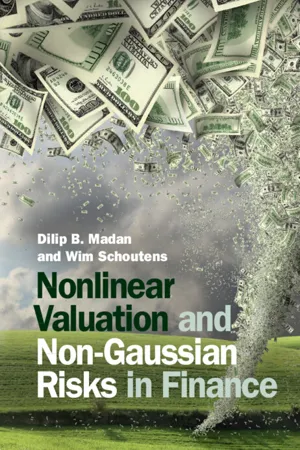
Nonlinear Valuation and Non-Gaussian Risks in Finance
About this book
What happens to risk as the economic horizon goes to zero and risk is seen as an exposure to a change in state that may occur instantaneously at any time? All activities that have been undertaken statically at a fixed finite horizon can now be reconsidered dynamically at a zero time horizon, with arrival rates at the core of the modeling. This book, aimed at practitioners and researchers in financial risk, delivers the theoretical framework and various applications of the newly established dynamic conic finance theory. The result is a nonlinear non-Gaussian valuation framework for risk management in finance. Risk-free assets disappear and low risk portfolios must pay for their risk reduction with negative expected returns. Hedges may be constructed to enhance value by exploiting risk interactions. Dynamic trading mechanisms are synthesized by machine learning algorithms. Optimal exposures are designed for option positioning simultaneously across all strikes and maturities.
Information
Table of contents
- Cover
- Half-title Page
- Title Page
- Copyright Page
- Dedication
- Contents
- Preface
- Acknowledgments
- 1 Introduction
- 2 Univariate Risk Representation Using Arrival Rates
- 3 Estimation of Univariate Arrival Rates from Time Series Data
- 4 Estimation of Univariate Arrival Rates from Option Surface Data
- 5 Multivariate Arrival Rates Associated with Prespecified Univariate Arrival Rates
- 6 The Measure-Distorted Valuation As a Financial Objective
- 7 Representing Market Realities
- 8 Measure-Distorted Value-Maximizing Hedges in Practice
- 9 Conic Hedging Contributions and Comparisons
- 10 Designing Optimal Univariate Exposures
- 11 Multivariate Static Hedge Designs Using Measure-Distorted Valuations
- 12 Static Portfolio Allocation Theory for Measure-Distorted Valuations
- 13 Dynamic Valuation via Nonlinear Martingales and Associated Backward Stochastic Partial Integro-Differential Equations
- 14 Dynamic Portfolio Theory
- 15 Enterprise Valuation Using Infinite and Finite Horizon Valuation of Terminal Liquidation
- 16 Economic Acceptability
- 17 Trading Markovian Models
- 18 Market-Implied Measure-Distortion Parameters
- References
- Index
Trusted by 375,005 students
Access to over 1.5 million titles for a fair monthly price.
Study more efficiently using our study tools.
Frequently asked questions
Yes, you can cancel anytime from the Subscription tab in your account settings on the Perlego website. Your subscription will stay active until the end of your current billing period. Learn how to cancel your subscription
No, books cannot be downloaded as external files, such as PDFs, for use outside of Perlego. However, you can download books within the Perlego app for offline reading on mobile or tablet. Learn how to download books offline
Perlego offers two plans: Essential and Complete
- Essential is ideal for learners and professionals who enjoy exploring a wide range of subjects. Access the Essential Library with 800,000+ trusted titles and best-sellers across business, personal growth, and the humanities. Includes unlimited reading time and Standard Read Aloud voice.
- Complete: Perfect for advanced learners and researchers needing full, unrestricted access. Unlock 1.5M+ books across hundreds of subjects, including academic and specialized titles. The Complete Plan also includes advanced features like Premium Read Aloud and Research Assistant.
We are an online textbook subscription service, where you can get access to an entire online library for less than the price of a single book per month. With over 1.5 million books across 990+ topics, we’ve got you covered! Learn about our mission
Look out for the read-aloud symbol on your next book to see if you can listen to it. The read-aloud tool reads text aloud for you, highlighting the text as it is being read. You can pause it, speed it up and slow it down. Learn more about Read Aloud
Yes! You can use the Perlego app on both iOS and Android devices to read anytime, anywhere — even offline. Perfect for commutes or when you’re on the go.
Please note we cannot support devices running on iOS 13 and Android 7 or earlier. Learn more about using the app
Please note we cannot support devices running on iOS 13 and Android 7 or earlier. Learn more about using the app
Yes, you can access Nonlinear Valuation and Non-Gaussian Risks in Finance by Dilip B. Madan,Wim Schoutens in PDF and/or ePUB format, as well as other popular books in Mathematics & Applied Mathematics. We have over 1.5 million books available in our catalogue for you to explore.