- 402 pages
- English
- PDF
- Available on iOS & Android
eBook - PDF
About this book
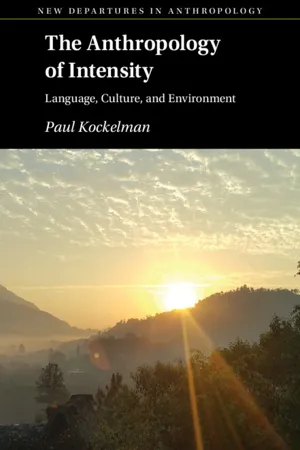
What counts as too close for comfort? How can an entire room suddenly feel restless at the imminence of a yet unknown occurrence? And who decides whether or not we are already in an age of unliveable extremes? The anthropology of intensity studies how humans encounter and communicate the continuous and gradable features of social and environmental phenomena in everyday interactions. Focusing on the last twenty years of life in a Mayan village in the cloud forests of Guatemala, this book provides a natural history of intensity in exceedingly tense times, through a careful analysis of ethnographic and linguistic evidence. It uses intensity as a way to reframe Anthropology in the age of the Anthropocene, and rethinks classic work in the formal linguistic tradition from a culture-specific and context-sensitive stance. It is essential reading not only for anthropologists and linguists, but also for ecologically oriented readers, critical theorists, and environmental scientists.
Information
Topic
Ciencias socialesSubtopic
AntropologíaTable of contents
- Cover
- Half-title
- Series Information
- Title Page
- Copyright Information
- Dedication
- Contents
- List of Figures
- list of Tables
- Acknowledgments
- List of Abbreviations
- Introduction: Intensity
- Part I Grounds
- Part II Tensors
- Part III Thresholds
- Conclusion: The Ecological Self
- References
- Index
Trusted by 375,005 students
Access to over 1.5 million titles for a fair monthly price.
Study more efficiently using our study tools.
Frequently asked questions
Yes, you can cancel anytime from the Subscription tab in your account settings on the Perlego website. Your subscription will stay active until the end of your current billing period. Learn how to cancel your subscription
No, books cannot be downloaded as external files, such as PDFs, for use outside of Perlego. However, you can download books within the Perlego app for offline reading on mobile or tablet. Learn how to download books offline
Perlego offers two plans: Essential and Complete
- Essential is ideal for learners and professionals who enjoy exploring a wide range of subjects. Access the Essential Library with 800,000+ trusted titles and best-sellers across business, personal growth, and the humanities. Includes unlimited reading time and Standard Read Aloud voice.
- Complete: Perfect for advanced learners and researchers needing full, unrestricted access. Unlock 1.5M+ books across hundreds of subjects, including academic and specialized titles. The Complete Plan also includes advanced features like Premium Read Aloud and Research Assistant.
We are an online textbook subscription service, where you can get access to an entire online library for less than the price of a single book per month. With over 1.5 million books across 990+ topics, we’ve got you covered! Learn about our mission
Look out for the read-aloud symbol on your next book to see if you can listen to it. The read-aloud tool reads text aloud for you, highlighting the text as it is being read. You can pause it, speed it up and slow it down. Learn more about Read Aloud
Yes! You can use the Perlego app on both iOS and Android devices to read anytime, anywhere — even offline. Perfect for commutes or when you’re on the go.
Please note we cannot support devices running on iOS 13 and Android 7 or earlier. Learn more about using the app
Please note we cannot support devices running on iOS 13 and Android 7 or earlier. Learn more about using the app
Yes, you can access The Anthropology of Intensity by Paul Kockelman in PDF and/or ePUB format, as well as other popular books in Ciencias sociales & Antropología. We have over 1.5 million books available in our catalogue for you to explore.