- 786 pages
- English
- PDF
- Available on iOS & Android
eBook - PDF
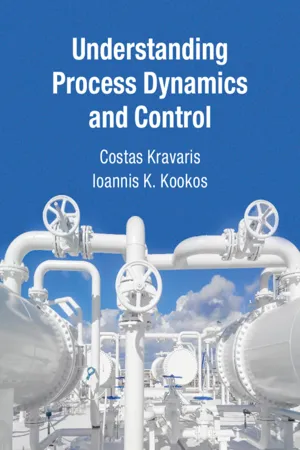
Understanding Process Dynamics and Control
About this book
Presenting a fresh look at process control, this new text demonstrates state-space approach shown in parallel with the traditional approach to explain the strategies used in industry today. Modern time-domain and traditional transform-domain methods are integrated throughout and explain the advantages and limitations of each approach; the fundamental theoretical concepts and methods of process control are applied to practical problems. To ensure understanding of the mathematical calculations involved, MATLAB® is included for numeric calculations and MAPLE for symbolic calculations, with the math behind every method carefully explained so that students develop a clear understanding of how and why the software tools work. Written for a one-semester course with optional advanced-level material, features include solved examples, cases that include a number of chemical reactor examples, chapter summaries, key terms, and concepts, as well as over 240 end-of-chapter problems, focused computational exercises and solutions for instructors.
Information
Table of contents
- Cover
- Half-title page
- Series page
- Title page
- Copyright page
- Dedication
- Contents
- Preface
- 1 INTRODUCTION
- 2 DYNAMIC MODELS FOR CHEMICAL PROCESS SYSTEMS
- 3 FIRST-ORDER SYSTEMS
- 4 CONNECTIONS OF FIRST-ORDER SYSTEMS
- 5 SECOND-ORDER SYSTEMS
- 6 LINEAR HIGHER-ORDER SYSTEMS
- 7 EIGENVALUE ANALYSIS – ASYMPTOTIC STABILITY
- 8 TRANSFER-FUNCTION ANALYSIS OF THE INPUT–OUTPUT BEHAVIOR
- 9 FREQUENCY RESPONSE
- 10 THE FEEDBACK CONTROL SYSTEM
- 11 BLOCK-DIAGRAM REDUCTION AND TRANSIENT-RESPONSE CALCULATION IN A FEEDBACK CONTROL SYSTEM
- 12 STEADY-STATE AND STABILITY ANALYSIS OF THE CLOSED-LOOP SYSTEM
- 13 STATE-SPACE DESCRIPTION AND ANALYSIS OF THE CLOSED-LOOP SYSTEM
- 14 SYSTEMS WITH DEAD TIME
- 15 PARAMETRIC ANALYSIS OF CLOSED-LOOP DYNAMICS – ROOT-LOCUS DIAGRAMS
- 16 OPTIMAL SELECTION OF CONTROLLER PARAMETERS
- 17 BODE AND NYQUIST STABILITY CRITERIA – GAIN AND PHASE MARGINS
- 18 MULTI-INPUT–MULTI-OUTPUT SYSTEMS
- 19 SYNTHESIS OF MODEL-BASED FEEDBACK CONTROLLERS
- 20 CASCADE, RATIO AND FEEDFORWARD CONTROL
- APPENDIX A LAPLACE TRANSFORM
- APPENDIX B BASIC MATRIX THEORY
- Index
Trusted by 375,005 students
Access to over 1.5 million titles for a fair monthly price.
Study more efficiently using our study tools.
Frequently asked questions
Yes, you can cancel anytime from the Subscription tab in your account settings on the Perlego website. Your subscription will stay active until the end of your current billing period. Learn how to cancel your subscription
No, books cannot be downloaded as external files, such as PDFs, for use outside of Perlego. However, you can download books within the Perlego app for offline reading on mobile or tablet. Learn how to download books offline
Perlego offers two plans: Essential and Complete
- Essential is ideal for learners and professionals who enjoy exploring a wide range of subjects. Access the Essential Library with 800,000+ trusted titles and best-sellers across business, personal growth, and the humanities. Includes unlimited reading time and Standard Read Aloud voice.
- Complete: Perfect for advanced learners and researchers needing full, unrestricted access. Unlock 1.5M+ books across hundreds of subjects, including academic and specialized titles. The Complete Plan also includes advanced features like Premium Read Aloud and Research Assistant.
We are an online textbook subscription service, where you can get access to an entire online library for less than the price of a single book per month. With over 1.5 million books across 990+ topics, we’ve got you covered! Learn about our mission
Look out for the read-aloud symbol on your next book to see if you can listen to it. The read-aloud tool reads text aloud for you, highlighting the text as it is being read. You can pause it, speed it up and slow it down. Learn more about Read Aloud
Yes! You can use the Perlego app on both iOS and Android devices to read anytime, anywhere — even offline. Perfect for commutes or when you’re on the go.
Please note we cannot support devices running on iOS 13 and Android 7 or earlier. Learn more about using the app
Please note we cannot support devices running on iOS 13 and Android 7 or earlier. Learn more about using the app
Yes, you can access Understanding Process Dynamics and Control by Costas Kravaris,Ioannis K. Kookos in PDF and/or ePUB format, as well as other popular books in Technology & Engineering & Chemical & Biochemical Engineering. We have over 1.5 million books available in our catalogue for you to explore.