eBook - PDF
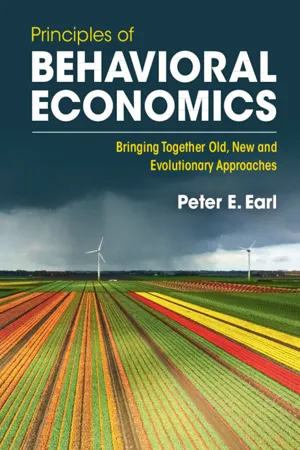
Principles of Behavioral Economics
Bringing Together Old, New and Evolutionary Approaches
- 542 pages
- English
- PDF
- Available on iOS & Android
eBook - PDF
Principles of Behavioral Economics
Bringing Together Old, New and Evolutionary Approaches
About this book
This book is unique among modern contributions to behavioral economics in presenting a grand synthesis between the kind of behavioral economics popularized by Richard Thaler, earlier approaches such as those of the 1978 Nobel Laureate Herbert Simon, evolutionary psychology, and evolutionary economics from Veblen and Marshall through to neo-Schumpeterian thinking. The synthesis employs a complex adaptive systems approach to how people think, the lifestyles they build, and how new production technologies and products are gradually adopted and produce changes. Using a huge range of examples, it takes behavioral economics from its recent focus on 'nudging' consumers, to the behavior of firms and other organizations, the challenges of achieving structural change and transitioning to environmentally sustainable lifestyles, and instability of the financial system. This book will be of great interest to academics and graduate students who seek a broader view of what behavioral economics is and what it might become.
Information
Table of contents
- Cover
- Half-title
- Title page
- Copyright information
- Contents
- List of Figures
- List of Tables
- Preface
- Acknowledgments
- 1 What Is Behavioral Economics?
- 2 What Motivates Us?
- 3 Why Is Life So Full of Problems for Us to Try to Solve?
- 4 How Do We Acknowledge Problems and Assess Options?
- 5 How Do We Deal with Uncertainty and Ambiguity?
- 6 How Do We Search for Solutions to Problems?
- 7 Why Do Some Things Matter More Than Others?
- 8 How Do We Choose?
- 9 How Can Firms and Governments Influence Our Choices?
- 10 What Determines the Productivity of an Organization?
- 11 How Does the Competitive Process Work?
- 12 Are There Any Behavioral Insights for Macroeconomists?
- 13 Can We Be Happy without Destroying the Environment?
- References
- Index
Trusted by 375,005 students
Access to over 1.5 million titles for a fair monthly price.
Study more efficiently using our study tools.
Frequently asked questions
Yes, you can cancel anytime from the Subscription tab in your account settings on the Perlego website. Your subscription will stay active until the end of your current billing period. Learn how to cancel your subscription
No, books cannot be downloaded as external files, such as PDFs, for use outside of Perlego. However, you can download books within the Perlego app for offline reading on mobile or tablet. Learn how to download books offline
Perlego offers two plans: Essential and Complete
- Essential is ideal for learners and professionals who enjoy exploring a wide range of subjects. Access the Essential Library with 800,000+ trusted titles and best-sellers across business, personal growth, and the humanities. Includes unlimited reading time and Standard Read Aloud voice.
- Complete: Perfect for advanced learners and researchers needing full, unrestricted access. Unlock 1.5M+ books across hundreds of subjects, including academic and specialized titles. The Complete Plan also includes advanced features like Premium Read Aloud and Research Assistant.
We are an online textbook subscription service, where you can get access to an entire online library for less than the price of a single book per month. With over 1.5 million books across 990+ topics, we’ve got you covered! Learn about our mission
Look out for the read-aloud symbol on your next book to see if you can listen to it. The read-aloud tool reads text aloud for you, highlighting the text as it is being read. You can pause it, speed it up and slow it down. Learn more about Read Aloud
Yes! You can use the Perlego app on both iOS and Android devices to read anytime, anywhere — even offline. Perfect for commutes or when you’re on the go.
Please note we cannot support devices running on iOS 13 and Android 7 or earlier. Learn more about using the app
Please note we cannot support devices running on iOS 13 and Android 7 or earlier. Learn more about using the app
Yes, you can access Principles of Behavioral Economics by Peter E. Earl in PDF and/or ePUB format, as well as other popular books in Economics & Microeconomics. We have over 1.5 million books available in our catalogue for you to explore.