- 278 pages
- English
- PDF
- Available on iOS & Android
eBook - PDF
About this book
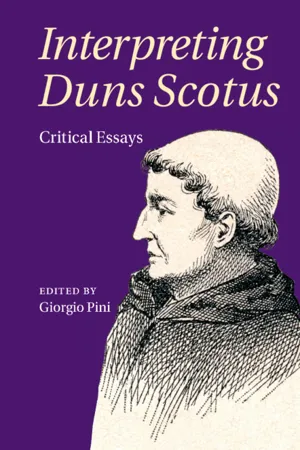
John Duns Scotus is commonly recognized as one of the most original thinkers of medieval philosophy. His influence on subsequent philosophers and theologians is enormous and extends well beyond the limits of the Middle Ages. His thought, however, might be intimidating for the non-initiated, because of the sheer number of topics he touched on and the difficulty of his style. The eleven essays collected here, especially written for this volume by some of the leading scholars in the field, take the reader through various topics, including Duns Scotus's intellectual environment, his argument for the existence of God, and his conceptions of modality, order, causality, freedom, and human nature. This volume provides a reliable point of entrance to the thought of Duns Scotus while giving a snapshot of some of the best research that is now being done on this difficult but intellectually rewarding thinker.
Information
Topic
PhilosophyTable of contents
- Cover
- Half-title
- Title page
- Copyright information
- Contents
- Acknowledgments
- Notes on contributors
- Introduction
- Chapter 1 John Duns Scotus's life in context
- Chapter 2 The modal framework of Duns Scotus's argument for the existence of a first cause
- Chapter 3 Duns Scotus on essential order in De Primo Principio and elsewhere
- Chapter 4 Duns Scotus on how God causes the created will's volitions
- Chapter 5 Duns Scotus on free will and human agency
- Chapter 6 Duns Scotus on the dignities of human nature
- Chapter 7 Duns Scotus on matter and form
- Chapter 8 Duns Scotus, intuitionism, and the third sense of 'natural law'
- Chapter 9 The bounds of sense: adequacy and abstraction in the later works of Duns Scotus
- Chapter 10 Before univocity: Duns Scotus's rejection of analogy
- Chapter 11 Analogy after Duns Scotus: the role of the analogia entis in the Scotist metaphysics at Barcelona, 1320-1330
- Bibliography
- Index
Trusted by 375,005 students
Access to over 1.5 million titles for a fair monthly price.
Study more efficiently using our study tools.
Frequently asked questions
Yes, you can cancel anytime from the Subscription tab in your account settings on the Perlego website. Your subscription will stay active until the end of your current billing period. Learn how to cancel your subscription
No, books cannot be downloaded as external files, such as PDFs, for use outside of Perlego. However, you can download books within the Perlego app for offline reading on mobile or tablet. Learn how to download books offline
Perlego offers two plans: Essential and Complete
- Essential is ideal for learners and professionals who enjoy exploring a wide range of subjects. Access the Essential Library with 800,000+ trusted titles and best-sellers across business, personal growth, and the humanities. Includes unlimited reading time and Standard Read Aloud voice.
- Complete: Perfect for advanced learners and researchers needing full, unrestricted access. Unlock 1.5M+ books across hundreds of subjects, including academic and specialized titles. The Complete Plan also includes advanced features like Premium Read Aloud and Research Assistant.
We are an online textbook subscription service, where you can get access to an entire online library for less than the price of a single book per month. With over 1.5 million books across 990+ topics, we’ve got you covered! Learn about our mission
Look out for the read-aloud symbol on your next book to see if you can listen to it. The read-aloud tool reads text aloud for you, highlighting the text as it is being read. You can pause it, speed it up and slow it down. Learn more about Read Aloud
Yes! You can use the Perlego app on both iOS and Android devices to read anytime, anywhere — even offline. Perfect for commutes or when you’re on the go.
Please note we cannot support devices running on iOS 13 and Android 7 or earlier. Learn more about using the app
Please note we cannot support devices running on iOS 13 and Android 7 or earlier. Learn more about using the app
Yes, you can access Interpreting Duns Scotus by Giorgio Pini in PDF and/or ePUB format, as well as other popular books in Philosophy & Medieval & Renaissance Philosophy. We have over 1.5 million books available in our catalogue for you to explore.