- 336 pages
- English
- PDF
- Available on iOS & Android
eBook - PDF
About this book
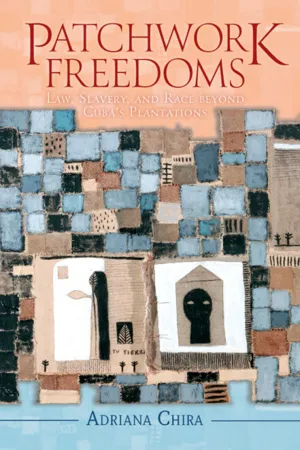
In nineteenth-century Santiago de Cuba, the island of Cuba's radical cradle, Afro-descendant peasants forged freedom and devised their own formative path to emancipation. Drawing on understudied archives, this pathbreaking work unearths a new history of Black rural geography and popular legalism, and offers a new framework for thinking about nineteenth-century Black freedom. Santiago de Cuba's Afro-descendant peasantries did not rely on liberal-abolitionist ideologies as a primary reference point in their struggle for rights. Instead, they negotiated their freedom and land piecemeal, through colonial legal frameworks that allowed for local custom and manumission. While gradually wearing down the institution of slavery through litigation and self-purchase, they reimagined colonial racial systems before Cuba's intellectuals had their say. Long before residents of Cuba protested for national independence and island-wide emancipation in 1868, it was Santiago's Afro-descendant peasants who, gradually and invisibly, laid the groundwork for emancipation.
Information
Table of contents
- Cover
- Half-title
- Series information
- Title page
- Copyright information
- Dedication
- Contents
- List of Figures
- List of Maps
- List of Tables
- Acknowledgments
- Manuscript Sources and Abbreviations
- Note on Language and Region
- Introduction
- 1 Unenclosed People, Unenclosed Lands: Santiago de Cuba to 1800
- 2 Foreign Implants: The Saint-Domingue Refugees and the Limits of Plantation Development, 1791-1808
- 3 Keeping People Put: Enslaved Families, Policing, and the Reemergence of Coffee Planting, 1810s-1830s
- 4 Manumission's Legalities: From Need-Based Prerogatives to Merit-Based Entitlements
- 5 ''A Freedom with Further Bonds'': Free People of African Descent, Property Ownership, and Color Status
- 6 ''Para levantar los negros y proclamar la República'': The Beginnings of the Cuban Wars of Independence in Santiago de Cuba
- Conclusion
- Appendix A
- Appendix B
- Bibliography
- Index
Trusted by 375,005 students
Access to over 1.5 million titles for a fair monthly price.
Study more efficiently using our study tools.
Frequently asked questions
Yes, you can cancel anytime from the Subscription tab in your account settings on the Perlego website. Your subscription will stay active until the end of your current billing period. Learn how to cancel your subscription
No, books cannot be downloaded as external files, such as PDFs, for use outside of Perlego. However, you can download books within the Perlego app for offline reading on mobile or tablet. Learn how to download books offline
We are an online textbook subscription service, where you can get access to an entire online library for less than the price of a single book per month. With over 1.5 million books across 990+ topics, we’ve got you covered! Learn about our mission
Look out for the read-aloud symbol on your next book to see if you can listen to it. The read-aloud tool reads text aloud for you, highlighting the text as it is being read. You can pause it, speed it up and slow it down. Learn more about Read Aloud
Yes! You can use the Perlego app on both iOS and Android devices to read anytime, anywhere — even offline. Perfect for commutes or when you’re on the go.
Please note we cannot support devices running on iOS 13 and Android 7 or earlier. Learn more about using the app
Please note we cannot support devices running on iOS 13 and Android 7 or earlier. Learn more about using the app
Yes, you can access Patchwork Freedoms by Adriana Chira in PDF and/or ePUB format, as well as other popular books in History & Latin American & Caribbean History. We have over 1.5 million books available in our catalogue for you to explore.