eBook - PDF
Solo Dance in Archaic and Classical Greek Literature
Representing the Unruly Body
- 260 pages
- English
- PDF
- Available on iOS & Android
eBook - PDF
About this book
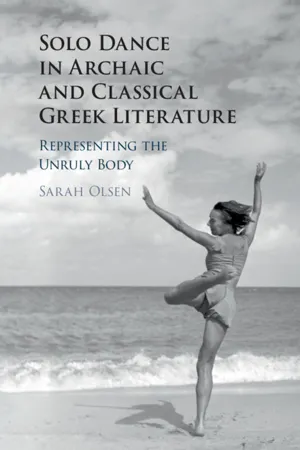
"Ancient Greek dance" traditionally evokes images of stately choruses or lively Dionysiac revels – communal acts of performance. This is the first book to look beyond the chorus to the diverse and complex representation of solo dancers in Archaic and Classical Greek literature. It argues that dancing alone signifies transgression and vulnerability in the Greek cultural imagination, as isolation from the chorus marks the separation of the individual from a range of communal social structures. It also demonstrates that the solo dancer is a powerful figure for literary exploration and experimentation, highlighting the importance of the singular dancing body in the articulation of poetic, narrative, and generic interests across Greek literature. Taking a comparative approach and engaging with current work in dance and performance studies, this book reveals the profound literary and cultural importance of the unruly solo dancer in the ancient Greek world.
Information
Topic
GeschichteSubtopic
AltertumTable of contents
- Cover
- Half-title page
- Title page
- Copyright page
- Dedication
- Contents
- List of Figures
- Acknowledgments
- Notes on Texts, Abbreviations, and Style
- Introduction: Dance, Literature, and Culture
- Chapter 1 The Fantastic Phaeacians: Virtuosity, Competition, and Dance in the Odyssey
- Chapter 2 Io’s Dance: Human Mobility and Divine Authority in Aeschylus’ Prometheus Bound
- Chapter 3 Dance at Work: Performance and Identity in Euripides’ Ion
- Chapter 4 Dance and Dissonance: The Innovative Choreography of Aristophanes’ Wasps
- Chapter 5 Staging Madwomen: Dance and Dramatic Form in Euripides and Aristophanes
- Chapter 6 Agency, Narrative, and the Dancing Girl
- Chapter 7 Dance History
- Conclusion: Reading Dance with Lucian
- Bibliography
- Index Locorum
- General Index
Trusted by 375,005 students
Access to over 1.5 million titles for a fair monthly price.
Study more efficiently using our study tools.
Frequently asked questions
Yes, you can cancel anytime from the Subscription tab in your account settings on the Perlego website. Your subscription will stay active until the end of your current billing period. Learn how to cancel your subscription
No, books cannot be downloaded as external files, such as PDFs, for use outside of Perlego. However, you can download books within the Perlego app for offline reading on mobile or tablet. Learn how to download books offline
Perlego offers two plans: Essential and Complete
- Essential is ideal for learners and professionals who enjoy exploring a wide range of subjects. Access the Essential Library with 800,000+ trusted titles and best-sellers across business, personal growth, and the humanities. Includes unlimited reading time and Standard Read Aloud voice.
- Complete: Perfect for advanced learners and researchers needing full, unrestricted access. Unlock 1.5M+ books across hundreds of subjects, including academic and specialized titles. The Complete Plan also includes advanced features like Premium Read Aloud and Research Assistant.
We are an online textbook subscription service, where you can get access to an entire online library for less than the price of a single book per month. With over 1.5 million books across 990+ topics, we’ve got you covered! Learn about our mission
Look out for the read-aloud symbol on your next book to see if you can listen to it. The read-aloud tool reads text aloud for you, highlighting the text as it is being read. You can pause it, speed it up and slow it down. Learn more about Read Aloud
Yes! You can use the Perlego app on both iOS and Android devices to read anytime, anywhere — even offline. Perfect for commutes or when you’re on the go.
Please note we cannot support devices running on iOS 13 and Android 7 or earlier. Learn more about using the app
Please note we cannot support devices running on iOS 13 and Android 7 or earlier. Learn more about using the app
Yes, you can access Solo Dance in Archaic and Classical Greek Literature by Sarah Olsen in PDF and/or ePUB format, as well as other popular books in Geschichte & Altertum. We have over 1.5 million books available in our catalogue for you to explore.