eBook - PDF
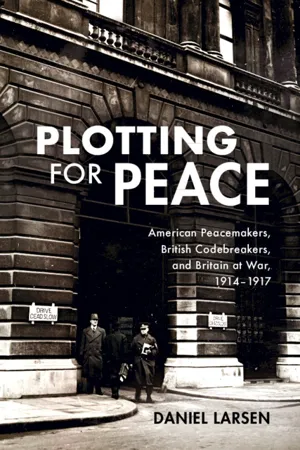
Plotting for Peace
American Peacemakers, British Codebreakers, and Britain at War, 1914–1917
- 446 pages
- English
- PDF
- Available on iOS & Android
eBook - PDF
Plotting for Peace
American Peacemakers, British Codebreakers, and Britain at War, 1914–1917
About this book
With Britain by late 1916 facing the prospect of an economic crisis and increasingly dependent on the US, rival factions in Asquith's government battled over whether or not to seek a negotiated end to the First World War. In this riveting new account, Daniel Larsen tells the full story for the first time of how Asquith and his supporters secretly sought to end the war. He shows how they supported President Woodrow Wilson's efforts to convene a peace conference and how British intelligence, clandestinely breaking American codes, aimed to sabotage these peace efforts and aided Asquith's rivals. With Britain reading and decrypting all US diplomatic telegrams between Europe and Washington, these decrypts were used in a battle between the Treasury, which was terrified of looming financial catastrophe, and Lloyd George and the generals. This book's findings transform our understanding of British strategy and international diplomacy during the war.
Information
Table of contents
- Cover
- Half-title
- Title page
- Copyright information
- Dedication
- Contents
- List of Figures
- List of Maps
- List of Graphs and Tables
- Dramatis Personae
- Preface
- Acknowledgements
- Introduction
- 1 The First Year of War: August 1914-August 1915
- 2 Strategy: August-December 1915
- 3 Negotiations: January-March 1916
- 4 Deliberations: March-May 1916
- 5 The Gamble: June-August 1916
- 6 The Knock-Out Blow: September-October 1916
- 7 The Fall of Asquith: October-December 1916
- 8 Peace Moves: December 1916-January 1917
- 9 The Zimmermann Telegram and Wilson's Move to War: February-April 1917
- Conclusion
- Appendix I The Gold Standard and the Fixed Exchange Rate
- Appendix II GDP of the United States, Britain, and France, 1914-1918
- Notes
- Bibliography
- Index
Trusted by 375,005 students
Access to over 1.5 million titles for a fair monthly price.
Study more efficiently using our study tools.
Frequently asked questions
Yes, you can cancel anytime from the Subscription tab in your account settings on the Perlego website. Your subscription will stay active until the end of your current billing period. Learn how to cancel your subscription
No, books cannot be downloaded as external files, such as PDFs, for use outside of Perlego. However, you can download books within the Perlego app for offline reading on mobile or tablet. Learn how to download books offline
Perlego offers two plans: Essential and Complete
- Essential is ideal for learners and professionals who enjoy exploring a wide range of subjects. Access the Essential Library with 800,000+ trusted titles and best-sellers across business, personal growth, and the humanities. Includes unlimited reading time and Standard Read Aloud voice.
- Complete: Perfect for advanced learners and researchers needing full, unrestricted access. Unlock 1.5M+ books across hundreds of subjects, including academic and specialized titles. The Complete Plan also includes advanced features like Premium Read Aloud and Research Assistant.
We are an online textbook subscription service, where you can get access to an entire online library for less than the price of a single book per month. With over 1.5 million books across 990+ topics, we’ve got you covered! Learn about our mission
Look out for the read-aloud symbol on your next book to see if you can listen to it. The read-aloud tool reads text aloud for you, highlighting the text as it is being read. You can pause it, speed it up and slow it down. Learn more about Read Aloud
Yes! You can use the Perlego app on both iOS and Android devices to read anytime, anywhere — even offline. Perfect for commutes or when you’re on the go.
Please note we cannot support devices running on iOS 13 and Android 7 or earlier. Learn more about using the app
Please note we cannot support devices running on iOS 13 and Android 7 or earlier. Learn more about using the app
Yes, you can access Plotting for Peace by Daniel Larsen in PDF and/or ePUB format, as well as other popular books in Politics & International Relations & Political History & Theory. We have over 1.5 million books available in our catalogue for you to explore.